Pre-match research gives you a direction. Live in-play betting gives you the edge.
The difference between a pre-match session bet and a live in-play bet is information. When you place a bet before the toss, you are working with venue averages, team sheets, and conditional projections. When you place a bet at over 8 — with 3 wickets down, the pitch clearly turning, and the bowling team’s primary spinner two overs into a dominant spell — you are working with facts. Real, confirmed, match-specific information that was not available before a ball was bowled.
For Indian exchange bettors in IPL 2026, live betting is the single most information-rich environment available. Every wicket, every boundary, every bowling change is a new data point that updates the probability of session and match outcomes. The bettors who learn to read these signals in real time — and execute on them within the narrow repricing windows that Indian exchanges offer — have a structural edge that no amount of pre-match research alone can replicate.
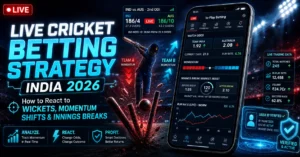
This complete guide covers the full architecture of live cricket betting strategy: how to react to wickets at every stage of the innings, how to read momentum shifts, how to trade the innings break, when to cash out, and the platform-specific timing principles that separate sharp live bettors from reactive ones.
What Is Live Cricket Betting Strategy (In-Play Betting)?
Live cricket betting strategy — also called in-play betting — is placing bets on markets that are updated ball by ball during a cricket match. On Indian exchanges (Diamond Exchange, Sky Exchange, Lotus365, JioFairPlay), live markets include:
- Match winner — updated odds every ball based on match state
- Session over/under — powerplay, middle overs, death over session lines
- Innings total — projected full innings total, over/under
- Individual ball outcomes — some exchanges offer ball-by-ball markets
- Player runs — individual batter run lines updated during innings
Live betting is fundamentally different from pre-match betting in one critical way: the market is always priced on the last available information, not the best available information. Exchange market makers update lines reactively — they price what just happened, not what is about to happen. A bettor who has pre-formed a conditional view and can execute faster than the market reprices has a genuine, consistent edge.
The Core Principle of Live Cricket Betting Strategy
The edge window principle:
Every major event in a cricket match — a wicket, a boundary, a bowling change, a wide — creates a brief period where the market’s new price is between two equilibria:
- The old price (before the event)
- The correctly adjusted new price (after the market fully processes the event)
This transition takes 15-45 seconds on most Indian exchanges. In that window, the price is still adjusting — meaning you can enter a position at a price that is better than the fully-adjusted equilibrium price will be.
The bettor who has pre-formed conditional views executes in this window.
The bettor who is still deciding what the wicket means misses it entirely.
This is why the pre-match framework from our IPL 2026 Match Betting Hints page is so important — it is not just pre-match preparation, it is live betting preparation. Every conditional view you form before the match (“if opener is dismissed in overs 1-3, enter Under on powerplay”) becomes an executable instruction during the match, with no deliberation required.
How to React to Wickets — By Innings Phase
Wickets in the Powerplay (Overs 1-6)
The powerplay is the most wicket-sensitive phase of the innings for session betting purposes.
First wicket — ball 1-12 (overs 1-2):
This is the highest-impact wicket in T20 cricket from a session betting perspective. The opening partnership is broken before the batting team has established any rhythm or platform.
Immediate market reactions:
- Powerplay session Over line drops by 6-10 runs within 30 seconds
- Match winner odds shift toward bowling team — typically 5-10% movement
- Incoming batter’s quality determines the follow-up action
Your decision tree:
- If the incoming batter at #3 is an aggressive power-hitter (Suryakumar Yadav, Tilak Varma, etc.): Neutral to Over — aggression compensates for early wicket
- If the incoming batter at #3 is a technically-oriented player: Under — consolidation mode begins, powerplay total will be below venue average
- If two specialist openers are still not out but one is struggling: Wait — watch the next 6 balls before acting
Execution: Enter your chosen position within 25 seconds of the dismissal. The 30-40 second window is your entire execution horizon.
First wicket — overs 3-6:
The impact is still significant but less dramatic than an over 1 dismissal. The batting team has some platform and the surviving opener has already assessed the pitch.
Market reaction: Powerplay Over line drops 3-6 runs. Less dramatic than early dismissal.
Your decision tree:
- Score at wicket = 30+ (above average pace): Over still viable — surviving opener can accelerate
- Score at wicket = 15-25 (average pace): Neutral — assess incoming batter quality
- Score at wicket = under 15 (below average pace): Under — two problems converging: slow start AND wicket loss
Two wickets in powerplay (any point overs 1-6):
Two powerplay wickets is the strongest single Under signal in T20 cricket. Regardless of venue, team, or match context — a batting team with 2 wickets down in the first 6 overs is in preservation mode.
Market reaction: Over line drops 10-15 runs. Match winner odds move significantly toward bowling team.
Action: If you were pre-positioned on Over for the powerplay session: exit the position immediately — within 15 seconds if possible, before the market fully adjusts Down.
If you were neutral pre-match: Enter Under within 30 seconds. Two-wicket powerplay sessions average 8-12 runs below venue baseline.
Wickets in the Middle Overs (Overs 7-15)
The middle overs are the most complex phase for live betting — partly because the market is hardest to read, and partly because the session lines for middle overs are the least exploitable of all three phases. However, specific wicket signals in overs 7-15 have clear implications for death over session and match winner markets.
Key batter dismissed in overs 7-12:
This is the most important middle overs wicket signal for death over session betting. If the team’s primary finisher — the player designated for overs 16-20 — is dismissed in the middle overs before they get to the death phase, the death over Under becomes significantly supported.
Example:
- MS Dhoni (CSK’s death specialist) dismissed at over 10
- At over 15, the session market may not fully reflect his absence — market makers sometimes price the team’s general batting quality rather than specifically accounting for who is missing
- This is the middle overs wicket insight: the death over session line has not fully adjusted to the loss of the primary finisher. Enter Under on death overs at over 15 when the specialist finisher was dismissed in overs 10-15.
Wicket of an anchor batter (middle-order consolidator) in overs 12-15:
Less impactful on death over session (consolidators are not the primary death scorers anyway) but affects match winner if the batting team needed that anchor to get the finishers into position.
Wickets in the Death Overs (Overs 16-20)
Death over wickets are covered comprehensively in our Death Over Session Betting Tips guide — but the live match winner implications of death wickets are worth addressing separately here:
Wicket in over 16 or 17 (specialist finisher):
- Death over session Under (see death over guide for entry mechanics)
- Match winner odds also shift significantly — a team losing their primary finisher in over 16 rarely posts a total above their original projection. Bowling team match winner becomes more attractive.
Wicket in over 18 with 2 wickets remaining:
- Under on death session (overwhelmingly)
- Match winner lean to bowling team — especially if the batting team was already under pressure on run rate
The tail-end scenario (over 19, 2 wickets left, 12+ needed):
The batting team can still win from this position in T20 cricket — tail-enders can hit sixes. However, statistically the bowling team closes out approximately 75% of these scenarios in IPL 2026. The live match winner Under on the batting team is a value entry in this scenario.
Reading Momentum Shifts — Beyond Wickets
Wickets are the most obvious live signal — but momentum shifts without wickets are equally important and significantly harder for market makers to price accurately.
The Bowling Spell Signal
When a bowler delivers 3 consecutive dot balls in the middle overs — the batting team’s run rate is under acute pressure even without a wicket falling. The session line is drifting toward Under territory without a formal event (wicket) to trigger market repricing.
How to use it:
If a bowler delivers 4+ dot balls in a 6-ball over in overs 8-12, the batting team is under pressure and the middle overs session total is trending Under. The market may not reprice immediately because no wicket has fallen. This is a soft momentum signal — enter Under on the current session at a price that has not yet adjusted to the dot-ball pressure.
The Boundary Cluster Signal
Three or more consecutive boundaries (4s or 6s) in a 6-ball over in overs 7-15 creates a momentum shift in the opposite direction — the batting team has broken free of pressure and the Over on remaining sessions becomes more supported.
How to use it:
After a 20+ run over in the middle phase, the innings total projection has shifted significantly. If you were holding a neutral position, the 20+ over is the trigger to enter Over on the death session — the batting team is now in flow and the remaining batters will have higher confidence.
The Bowling Change Signal
When a captain makes a surprising bowling change — bringing on a batter or fifth-choice bowler in overs 12-15 — it signals that their primary bowling resources are either depleted or being preserved for the death. This is an Over signal for the current and subsequent session.
The key read: Is this a planned rotation or a desperation change? If the two frontline pacers have already bowled their 4 overs by over 12, the opposition batting team faces inferior bowling for overs 12-18 — structural Over lean for that period.
Trading the Innings Break — The Most Underused Live Betting Window
The innings break in a T20 match is a 3-5 minute window between innings during which match winner odds are fully live on Indian exchanges. This is one of the most underused live betting windows available.
Why the innings break is valuable:
At the innings break you know:
- ✅ The exact target (e.g., Team B needs 187 in 20 overs)
- ✅ The pitch condition after 20 overs of first innings (drier, more variable, slower)
- ✅ Whether dew has developed (humidity, venue, evening timing all confirmable by now)
- ✅ Both team XIs and which bowlers/batters have performed well in first innings
- ✅ Match momentum — which team’s bowlers/batters are in form on this specific pitch today
The innings break market analysis framework:
Step 1: Classify the target
- Below 150: Low target — chasing team is strong favourite. Defensive chase reduces risk. Under on chasing team session totals.
- 150-175: Competitive target — context and chasing team strength determine lean.
- 176-195: High target — chasing team needs to maintain 9+ per over throughout. Over on powerplay session for chasing team if they have aggressive openers.
- 196+: Very high target — chasing team must attack from ball 1. Strong Over on chasing powerplay session.
Step 2: Assess pitch state
After 20 overs of first innings batting, the pitch is drier, the surface is slower, and variable bounce may have developed (especially at Chepauk or Dharamsala). If the first innings pitch played slower than expected — adjust chasing team powerplay session Down by 3-5 runs.
Step 3: Dew at innings break
At dew-prone venues (Wankhede, Eden Gardens, Ahmedabad) in evening matches, dew is typically at its peak during the chasing innings. This means the chasing team’s powerplay and middle overs are easier than the first innings equivalents were. Over lean for chasing team sessions if dew is visible or forecast.
Step 4: Enter match winner bet at innings break
Match winner odds at the innings break are the most information-rich prices of the entire match. They incorporate the target, the pitch state, and the match context. However — they are also efficiently set by this point. The narrow edge windows available are:
- When the target is in the borderline range (165-180) and you have specific knowledge of dew state, chasing lineup quality, or bowling matchup advantages that the market may not have fully priced.
- When a key first innings bowler has underperformed and has fewer quality overs remaining — this is less visible to market makers who price based on team-level data.
Exchange Timing — Platform-Specific Live Betting Principles
Not all Indian exchanges update at the same speed. Understanding platform-specific timing is part of live betting strategy.
General Indian exchange live betting principles:
Principle 1: Pre-position before events
The biggest edge in live betting is entering a position before a predictable event rather than reacting after it. If you identify that a specific bowler will bowl over 20 and you want to back Under on death session — enter at over 18 or 19, not after the bowler is announced. Post-announcement prices are already adjusted.
Principle 2: Event repricing window
After major events (wickets, boundaries, bowling changes) the repricing window is:
- Wicket: 20-40 seconds before price stabilises at new level
- 6-ball over result: 10-15 seconds
- Milestone (50-run partnership): 15-25 seconds
Principle 3: Mobile vs desktop timing
On mobile apps, the live bet submission is slightly faster than desktop browser interfaces for most Indian exchanges. If live timing is important to your strategy, use the exchange mobile app rather than a browser.
Principle 4: Never bet in the last 10 seconds of an over
The over boundary is a natural repricing event — the market frequently suspends or adjusts sharply at the end of an over. Entering in the last 2-3 balls of an over risks placing a bet that is voided or settled at an unexpected price. Enter at the start of overs, not at the end.
Principle 5: Know your exchange’s suspension policy
Some Indian exchanges suspend markets during balls that produce significant events (wickets, sixes). This means your live bet attempt during a dramatic ball may fail. Accept this as a platform limitation and retarget your entry to the next delivery.
The Live Betting Decision Tree — Complete Reference
Use this decision tree during any IPL match:
Event: Key opener dismissed, powerplay overs 1-2
→ Check incoming batter (#3) quality
→ Aggressive #3: Neutral/Over, enter within 30 seconds
→ Conservative #3: Under, enter within 20 seconds
Event: Two wickets in powerplay
→ Under on powerplay session, enter within 20 seconds
→ Exit any pre-existing Over position immediately
Event: 20+ run over in overs 7-12
→ Over lean on death overs session
→ Re-evaluate match winner odds — batting team momentum
Event: 4+ consecutive dot balls in overs 8-12
→ Under signal for current middle overs session
→ Soft signal — smaller stake, confirm with next over
Event: Primary finisher dismissed in overs 10-15
→ Note for death over entry at over 15
→ Under on death over session at over 15 — market may not have fully adjusted
Event: Elite death bowler (Bumrah) has over 19-20 available
→ Under lean on death over session
→ Strongest if batting team also losing wickets in overs 14-15
Event: Innings break, target 186+
→ Over on chasing team powerplay session
→ Chasing team must attack from ball 1 — aggression is mandatory
Event: Innings break, target under 150
→ Under on chasing team death over session
→ Controlled chase — no need to take risks in death overs
4 Worked Live Betting Examples — IPL 2026
Example 1 — Opener Dismissed Over 1, Wankhede ✅ Under
Situation: MI opener dismissed ball 3, over 1. Score 0/1. Exchange has powerplay Over/Under line at 62.
Incoming batter: Middle-order consolidator at #3 — not a power-hitter.
Decision: Under on powerplay — conservative #3 will not compensate for early dismissal at over 1.
Entry: Within 20 seconds. Line has dropped from 62 to 55 — entered Under at 55.
Result: MI powerplay 48. Under confirmed.
Example 2 — Momentum Shift via Bowling Spell, Middle Overs ✅ Under on Death Session
Situation: Overs 9-12, RCB spinner delivers four consecutive dot-ball overs. Score 72/2 at over 12.
Analysis: No wicket has fallen but run rate is suppressed — scoring momentum clearly with bowlers. Pre-match conditional view: “If run rate under 7 at over 12 AND spinner dominant → Under on death session.”
Entry: At over 12, death session line not yet fully adjusted (no wicket = soft market move). Entered Under at death session line 60.
Result: RCB 48 in death (7/8, 7/9 by over 16 — collapsed chasing target). Under confirmed.
Example 3 — Innings Break Trade, Target 191 ✅ Over on Chasing Powerplay
Situation: GT set target of 191 at Chinnaswamy. Innings break.
Analysis: Target 191 = chasing team needs 9.55/over — must attack from ball 1. Dew visible at Chinnaswamy. RCB openers (Virat Kohli aggressive mode + Faf) are the match’s strongest powerplay pair. Chasing powerplay session line set at 58.
Decision: Over at 58 — mandatory aggression + dew + attacking openers = over is a strong lean.
Result: RCB powerplay 67. Over confirmed. RCB won with 4 balls to spare.
Example 4 — Bumrah Over 19-20, Death Under ✅
Situation: SRH chasing 172. 130/5 at over 15. Death session line set at 55.
Analysis: 5 wickets down at over 15 — lean is already toward Under. But key additional signal: Bumrah has bowled only 2 overs to this point — he has 2 overs remaining, likely 19 and 20. With SRH already 5 down and Bumrah having 2 death overs available — death Under is overwhelming.
Entry: At start of over 16. Death session Under at 55.
Result: SRH posted 36 in death (Bumrah: over 19 — 1 wicket, 5 runs; over 20 — 2 wickets, 4 runs). Under confirmed comfortably.
What Cash-Out Means in Indian Exchange Cricket Betting
Some Indian exchanges offer a cash-out feature — the ability to settle a bet before its natural conclusion at a reduced or modified return. This is relevant in live cricket betting strategy:
When to cash out:
- You entered Over on powerplay session pre-match. At over 3, score is 30/0 — Over already confirmed if trend continues. Exchange offers cash-out at 85% of original potential return. If the remaining 3 overs carry meaningful risk (e.g., rain approaching, pitch suddenly doing something), cashing out at 85% is rational.
- You entered match winner on Team A. At over 15, Team A has effectively won the match. Match winner live odds at 1.05 (95% implied probability). Cash out at 95% of full return — locked in profit with tiny remaining risk removed.
When NOT to cash out:
- Your position is in a clear winning direction with no meaningful risk remaining. Full settlement is better than early cash-out.
- The cash-out price is significantly below the implied probability your analysis suggests — the exchange is taking too much margin on the cash-out. Hold the position.
Live Betting Discipline — The Rules That Protect Your Budget
Live betting’s speed creates specific risks:
- Chasing losses in-play — a losing powerplay position triggering a reflexive death over Over bet to recover. Avoid.
- Doubling up after a missed entry — missing the entry window and placing a larger bet on the next signal to compensate. Avoid.
- Screen-addiction — betting every session of every match because the live market is always open. Avoid.
Live betting rules:
- Set a live bet budget separate from your pre-match budget — e.g., 30% of total match budget reserved for in-play entries
- Maximum 2 live positions per match — powerplay entry and death over entry. Not every session.
- Predetermined entry conditions only — only enter live positions that match a conditional view you formed pre-match. Reactive bets (entering without a pre-formed view) are the primary source of live betting losses.
- Accept missed windows — if you miss the 25-second entry window after a wicket, move on. Do not chase the same signal at a worse price.
Free, confidential support: iCall Helpline — 9152987821 (Hindi and English)
All content on BettingHints.co is for informational purposes only. Nothing on this page constitutes financial advice or a guarantee of results. Please bet responsibly. 18+ only.
Frequently Asked Questions
Q1. What is live cricket betting strategy and how does it work in India?
Live cricket betting strategy— also called in-play betting — lets you place bets on markets that update ball by ball during a match. On Indian exchanges (Diamond Exchange, Sky Exchange, Lotus365, JioFairPlay), live markets include match winner, session over/under, innings total, and player runs. Odds update in real time and the key skill is identifying when to enter in the brief repricing window after major events.
Q2. How quickly should I react after a wicket falls in live cricket betting strategy?
The repricing window after a wicket on Indian exchanges is 20-40 seconds before odds stabilise at the new level. You must have a pre-formed conditional view — deciding what a wicket means during those 20-40 seconds is too slow. Form your conditional views (“if opener dismissed in overs 1-2 with conservative #3 incoming → Under on powerplay”) before the match starts.
Q3. What is the most important live signal in T20 cricket betting?
Two wickets in the powerplay (overs 1-6) is the single strongest live Under signal in T20 cricket. Regardless of venue, team, or match context — a batting team 2 down in the first 6 overs is in preservation mode. The powerplay session Over should be exited and Under entered within 20 seconds.
Q4. How do I trade the innings break in IPL betting?
At the innings break you know the exact target, the pitch state after 20 overs, and dew development. Classify the target (below 150/competitive/high/very high), assess pitch state, check dew, and evaluate bowling matchup for the chasing innings. Match winner and powerplay session bets placed at the innings break are the most information-rich entries of the entire match.
Q5. Is live betting better than pre-match betting in IPL?
They serve different purposes. Pre-match betting is better for powerplay session markets where venue averages and team XI are the primary drivers. Live betting is better for death over session markets (entry at over 15 with real wicket-in-hand data) and match winner markets post-toss. The best approach uses both: pre-match for powerplay direction, in-play for death over entries.
Q6. What is the edge window in live cricket betting strategy?
The edge window is the 15-45 second period after a major match event (wicket, boundary, bowling change) during which exchange odds are transitioning between the old price and the correctly adjusted new price. Entering a position during this window gives you a better price than the fully-adjusted equilibrium — this is the fundamental source of live betting edge.
Q7. How many live bets should I place per IPL match?
A maximum of 2 live positions per match — typically a powerplay entry and a death over entry. Betting every session live on every match leads to high variance, rapid budget depletion, and loss of analytical discipline. Only enter live positions that match conditional views you formed before the match started.
BettingHints.co — Cricket Betting Strategy & Session Tips for India | bettinghints.co
© 2026 BettingHints.co. All Rights Reserved. 18+ Adults Only.
Related reading — recent guides on this site
- Cricket ID Selection By Strategy Style — In-play strategy has the most demanding cricket ID requirements around latency and market stability.
- Cricket ID Advanced Features Serious Bettors Use — Latency measurement and market depth matter specifically for in-play trading.
- Cricket ID Bankroll Segmentation — In-play warrants its own bankroll segment separate from pre-match.