Rain is the most disruptive and least understood variable in cricket betting. Every Indian bettor has experienced it — a match turns in your favour, clouds gather, play is suspended, and suddenly the match resumes under a revised DLS target that makes your carefully researched position irrelevant. Or worse — the match is abandoned and your bet is voided when you were winning.
Most bettors treat rain as pure bad luck. The sharp ones treat it as information.
Rain probability, cloud cover, venue drainage quality, IPL weather patterns by city — all of these are knowable before you place a bet. And when rain is likely, the way session markets and match winner odds behave creates specific exploitable patterns for bettors who understand what a DLS recalculation actually means for the markets they are holding.
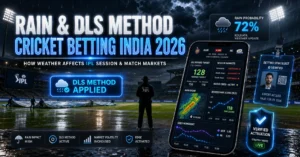
This complete guide covers everything you need to know about Rain And DLS Method Cricket Betting 2026 — how rain affects session bets, how DLS targets are recalculated and what that means for match winner odds, which venues are most rain-affected, and the specific strategies for matches where weather is a significant factor.
Understanding DLS — What Every Cricket Bettor Needs to Know
The Duckworth-Lewis-Stern (DLS) method is the mathematical formula used to recalculate targets in rain-affected limited-overs cricket matches. For bettors, understanding DLS at a functional level — not a mathematical one — is essential because DLS recalculation dramatically changes match winner probability.
The Core DLS Principle for Bettors
DLS works by calculating how many runs a team can be expected to score from the resources remaining — where resources are a combination of overs remaining and wickets in hand. When rain reduces overs, DLS recalculates the target based on the relative resources available to each team.
The key bettor insight about DLS:
DLS is not a neutral calculation — it systematically favours the chasing team in specific match situations. When a match is interrupted during the second innings chase, DLS typically sets a revised target that is either equal to or slightly below what the chasing team was on track to need. This is because DLS assumes a consistent run rate across the innings — but high-scoring T20 cricket concentrates runs in the powerplay and death overs, which DLS does not fully account for.
Practical implication:
If a match is rain-affected during the second innings chase and the chasing team is behind the DLS par score when rain arrives — the match winner odds on the bowling/defending team become more attractive. The chasing team needs to score faster than DLS par when play resumes — which is a structural disadvantage.
Conversely — if the chasing team is ahead of DLS par when rain arrives and the match is shortened, the chasing team becomes the strong favourite because DLS is likely to set them a reduced target.
How Rain Affects Different Bet Types — The Rules Framework
Before discussing strategy, you need to understand how Indian exchanges settle rain-affected bets. Rules vary by platform but these are the standard frameworks across Diamond Exchange, Sky Exchange, Lotus365, and JioFairPlay:
Match Winner Bets
| Scenario | Settlement |
| Match completed under DLS — result declared | Bet settled on official result |
| Match abandoned — no result | Bet voided — stake returned |
| Match reduced to minimum overs and completed | Bet settled on official result |
| Match suspended and not resumed on same day | Exchange-specific — usually voided |
Session Bets (Powerplay, Middle, Death)
Session bets are the most rain-sensitive market in cricket betting:
| Scenario | Settlement |
| Session completes fully before rain | Settled on actual runs scored |
| Rain interrupts during a session | Most exchanges void the session bet |
| Rain between innings (before second innings starts) | First innings session bets already settled, second innings session bets voided |
| Match reduced and session not bowled | Session bet voided, stake returned |
The critical rule: If you hold a powerplay session bet and rain interrupts during overs 1-6 before the session completes — most Indian exchanges void the bet and return your stake. This is the most common rain-betting confusion. Bettors assume they will lose or win based on the score at interruption — but void is the standard settlement.
Verify this rule on your specific exchange before every rain-risk match. Exchange terms differ and some platforms settle at the score at interruption rather than voiding.
Innings Total Bets
| Scenario | Settlement |
| Innings completes fully | Settled on actual total |
| First innings shortened by DLS | Settled on revised par score comparison if exchange rules allow, otherwise voided |
| Match abandoned | Voided |
IPL Venue Rain Risk Profiles — Pre-Match Reference
Not all IPL venues carry equal rain risk. This table is your pre-match rain probability reference for every IPL venue:
| Venue | City | Rain Risk | Peak Risk Season | Drainage Quality | Typical Delay Length |
| Eden Gardens | Kolkata | 🔴 HIGHEST | April-June (pre-monsoon) | Moderate | 30-90 mins |
| Wankhede Stadium | Mumbai | 🔴 HIGH | May-June (pre-monsoon) | Good but coastal humidity | 20-60 mins |
| MA Chidambaram | Chennai | 🟡 MEDIUM-HIGH | April-May (nor’easter storms) | Moderate | 30-60 mins |
| Ekana Stadium | Lucknow | 🟡 MEDIUM | April-May (thunderstorms) | Good | 20-40 mins |
| M. Chinnaswamy | Bengaluru | 🟡 MEDIUM | April-May (pre-monsoon) | Good | 20-45 mins |
| Narendra Modi | Ahmedabad | 🟢 LOW | Rarely | Excellent | 15-30 mins |
| Sawai Mansingh | Jaipur | 🟢 LOW | Rarely in April-May | Good | 15-30 mins |
| Rajiv Gandhi Intl. | Hyderabad | 🟡 MEDIUM | April-May | Good | 20-40 mins |
| Dharamsala (HPCA) | Himachal | 🔴 HIGH | April-May (mountain weather) | Moderate | Unpredictable — can be abandoned |
| Mullanpur | Chandigarh | 🟡 MEDIUM | April-May | Good | 20-40 mins |
The highest rain risk IPL venues in May-June 2026:
- Eden Gardens (Kolkata) — pre-monsoon thunderstorms are common in April-May and can arrive with very little warning
- Dharamsala — mountain weather is entirely unpredictable. Matches here have been abandoned mid-over without a result declared. This venue carries the highest outright abandonment risk in IPL.
- Wankhede (Mumbai) — coastal humidity and pre-monsoon storms particularly in May-June
How to Check Rain Probability Before Placing a Bet
Step 1: Weather check routine (30-60 minutes before every match)
For IPL matches, check:
- AccuWeather or Weather.com for the match city — hourly forecast for match start time
- Look specifically for: precipitation probability (%), cloud cover %, wind speed and direction
- For evening matches (7:30 PM IST): check the 7 PM-11 PM IST forecast window
Step 2: Rain probability thresholds for betting decisions
| Rain Probability | Action |
| Below 20% | Proceed normally — rain risk minimal |
| 20-40% | Note the risk — reduce session bet stake slightly |
| 40-60% | Significant rain risk — avoid session bets, match winner only with caution |
| Above 60% | High abandonment/DLS risk — avoid session bets entirely, reduce match winner stake significantly or skip |
| Above 80% | Match may not complete — session bets almost certainly void risk. Skip all markets or minimum stake match winner only |
Step 3: Check venue drainage quality
Narendra Modi Stadium (Ahmedabad) has world-class drainage — a 30-minute interruption often resumes play quickly. Eden Gardens with heavier rain may lose 60-90 minutes. The drainage quality determines how long an interruption lasts and therefore whether a revised DLS match is possible at all.
The DLS Par Score — Your In-Play Rain Betting Compass
During a rain interruption in the second innings, the DLS par score is the most important number for live match winner betting. It tells you exactly which team will win if the match is abandoned at that precise moment.
How to find the DLS par score during a match:
- ESPN Cricinfo live scorecard shows the DLS par score in real time during rain interruptions
- IPL official app updates the par score as overs are lost
- TV commentary always announces the par score when rain arrives
How to use the DLS par score for in-play betting:
Scenario A — Chasing team is AHEAD of DLS par when rain arrives:
- If match is abandoned now, chasing team wins
- Match winner odds immediately swing toward chasing team
- The longer the rain delay, the more overs potentially lost, but the chasing team maintains the DLS advantage
- Back chasing team match winner if the gap ahead of par is 5+ runs with 2+ overs still to play
Scenario B — Chasing team is BEHIND DLS par when rain arrives:
- If match abandoned now, defending/bowling team wins
- Match winner odds immediately swing toward defending team
- Back defending team match winner — but assess how far behind par. If only 2-3 runs behind with 4 overs to go, this is a volatile situation
Scenario C — Chasing team is exactly ON DLS par:
- Result is a tie/no result in some formats — exchange specific settlement
- Most volatile scenario — avoid entering new positions
Pre-Match Rain Strategy — How to Adjust Your Bets
When rain probability is significant (above 40%) for a match you are planning to bet on, apply these specific adjustments:
Adjustment 1: Reduce or Eliminate Session Bets
Session bets carry the highest rain void risk. If rain interrupts during the powerplay (overs 1-4) before the session completes, your bet is voided. You neither win nor lose the stake — but you lose the opportunity cost of having capital tied up.
At 40%+ rain probability: reduce session bet stake to 25-50% of normal unit
At 60%+ rain probability: avoid session bets entirely
Adjustment 2: Match Winner Becomes the Primary Market
Match winner bets settle on the official result — whether that result comes through DLS or not. This makes match winner the most rain-resilient market.
At 40%+ rain probability: shift budget allocation from session bets to match winner
Adjustment 3: Assess DLS Structural Advantage Pre-Match
Before a rain-risk match, identify which team has the DLS structural advantage if the match is shortened:
Team that benefits most from a shortened match:
- The team with the deeper batting lineup — DLS rewards wickets in hand at the point of interruption
- The team with the stronger powerplay — a 10-over DLS match concentrates runs in the phase where the stronger powerplay team has most advantage
- The team that is batting second — DLS targets are generally more achievable than first innings totals
Apply to betting:
If Team A has a clear DLS structural advantage (stronger powerplay, deeper lineup) and rain is likely — Team A’s match winner odds have additional hidden value beyond their standard win probability.
Rain-Affected Match Scenarios — 4 Worked Examples
Example 1 — Eden Gardens, 60% Rain Probability ✅ Correct Adjustment
Pre-match: KKR vs MI at Eden Gardens. Weather forecast: 65% rain probability from 8:30 PM. Match starts 7:30 PM.
Standard analysis: Eden Gardens batting surface — powerplay Over lean, KKR home advantage.
Rain adjustment: 65% rain probability = avoid session bets. Match winner only, reduced stake.
What happened: Rain arrived over 9. Match reduced to 15 overs each under DLS. KKR won DLS-adjusted match.
Result: Match winner bet settled normally. Session bets (had they been placed) on powerplay would have settled before rain — but middle overs session would have been voided.
Lesson: Above 60% rain probability — eliminate session bets. Match winner only.
Example 2 — DLS Par Score Live Bet ✅ Value Identified
Situation: CSK chasing 172 at Wankhede. Over 14: CSK 118/3 — 4 ahead of DLS par (par = 114 at this point).
Rain arrives during over 14. Match interrupted.
Analysis: CSK are ahead of par. If match abandoned now, CSK win. With 4-run lead on par and 6 wickets remaining, CSK are strong DLS favourites.
Exchange match winner odds at interruption: CSK 1.65 (market not yet fully reflecting DLS advantage)
Action: Back CSK match winner at 1.65 — DLS advantage is clear and price is slightly generous.
Result: Match resumed for 3 more overs. CSK won on DLS. Match winner bet confirmed.
Lesson: When the chasing team is ahead of DLS par with wickets in hand and rain arrives — match winner value frequently exists in the 30-60 second window before the market fully adjusts.
Example 3 — Dharamsala Abandonment Risk ✅ Avoided
Pre-match: PBKS vs RR at Dharamsala. Weather: mountain overcast with 70% precipitation risk from mid-afternoon.
Analysis: 70% rain risk at Dharamsala — the highest abandonment risk venue in IPL. Even good drainage cannot save a mountain weather abandonment.
Decision: Skip all markets — match winner abandonment void risk too high, session void risk overwhelmingly high.
Result: Match abandoned without result at over 8 of first innings. All bets voided. Stake returned.
Lesson: At Dharamsala with high rain probability — skip the match entirely. The void risk eliminates all potential value.
Example 4 — First Innings Rain, Second Innings Bet ✅ Adjusted Strategy
Situation: MI vs SRH at Wankhede. Rain arrives at over 12 of first innings. 35-minute delay.
First innings: MI 95/3 at over 12 when rain arrived. Resumed — MI finished 168 all out in 18 overs (DLS adjusted).
Innings break: SRH need 168 in 18 overs. Rain has cleared. No further rain expected.
Analysis: No rain risk for second innings. DLS target is 168 in 18 overs — slightly harder than 20-over equivalent. Powerplay Over lean for SRH (high-scoring team, aggressive openers, flat Wankhede surface). Normal second innings session betting is now valid — rain risk has passed.
Decision: Enter SRH powerplay Over normally. Full unit. No rain adjustment needed for second innings.
Result: SRH powerplay 63. Over confirmed.
Lesson: When first innings rain clears and second innings starts under clear skies — resume normal session betting framework for second innings. Do not carry rain caution into a clear-weather second innings.
Women’s T20 WC 2026 — Rain Considerations for England Venues
The Women’s T20 WC 2026 is held in England (June 12 – July 5). English summer weather is the most rain-variable conditions in world cricket — rain risk is a factor for every single match.
England rain betting rules for Women’s T20 WC:
- Minimum overs for result in Women’s T20: 10 overs per side required for a match to count
- English summer weather: Cloud cover is the norm — overcast conditions most days, afternoon/evening showers common
- Rain probability for England June-July: 30-50% on most days — significantly higher than any IPL venue in the same period
Women’s T20 WC rain strategy:
- For every Women’s T20 WC match in England: check hourly weather for the match city specifically
- If precipitation probability above 40%: reduce session bets to minimum or skip
- The match winner market is more rain-resilient — matches in England with 10+ overs per side complete and produce official results more often than full abandonments
- Reserve stake strategy: Hold 30% of your per-match budget specifically for post-rain DLS live betting — the innings break after a rain-affected first innings creates exploitable match winner mispricing windows
Reading Cloud Cover as a Powerplay Betting Signal
Even when rain does not arrive during the match, cloud cover is itself a powerplay betting signal — independent of rain risk.
Overcast conditions and swing bowling:
Overhead cloud cover keeps moisture in the air and makes the cricket ball swing — sometimes significantly. In the first 3-4 overs of a T20 innings under overcast conditions, quality pace bowlers generate more movement than they would under clear skies.
This directly impacts powerplay session betting:
- Heavy overcast + quality pace bowling attack: Adjust powerplay session expectation Down by 4-6 runs from venue average
- Light overcast, no seam bowlers: Minimal adjustment
- Clear skies: No cloud cover adjustment — standard venue average applies
Venues most affected by cloud cover swing:
England venues (all ICC matches) — most affected. Swing is a consistent feature of English conditions regardless of rain.
Dharamsala — mountain cloud cover creates swing conditions even without rain.
Eden Gardens morning/evening matches — humidity creates moderate swing.
Responsible Betting in Rain-Affected Matches
Rain creates a specific form of frustration-betting. A match turns in your favour, rain arrives, the match dynamic changes, and the impulse to place a reactive “recovery” bet to compensate for the disrupted position is powerful. This is one of the most common forms of impulsive betting in cricket.
The rain discipline rule:
When rain arrives during a match where you hold a position, your only actions should be:
- Check DLS par score on ESPNcricinfo
- Assess whether your position is helped or hurt by DLS par
- If helped — hold or consider strengthening at current odds
- If hurt — exit cleanly if the exchange allows, or hold if the market has already adjusted
Do not place new bets simply because rain has changed the match context. Rain creates chaos — chaos is not an analysis framework.
Free, confidential support: iCall Helpline — 9152987821 (Hindi and English)
All content on BettingHints.co is for informational purposes only. Nothing on this page constitutes financial advice or a guarantee of results. Please bet responsibly. 18+ only.
Frequently Asked Questions – Rain And DLS Method Cricket Betting
Q1. What happens to my session bet if rain stops play in an IPL match?
If rain interrupts during a session before it completes, most Indian exchanges void the session bet and return your stake. If the session completes before rain arrives, it is settled normally. Always verify your specific exchange’s rain settlement rules before placing session bets in rain-risk matches.
Q2. What is the DLS method and how does it affect cricket betting?
DLS (Duckworth-Lewis-Stern) is the mathematical method used to recalculate targets in rain-affected matches. For bettors, DLS determines match winner when overs are reduced. The key insight is that DLS structurally favours the chasing team in specific scenarios — particularly when the chase is interrupted with the chasing team ahead of par with wickets in hand.
Q3. Which IPL venue has the highest rain risk?
Eden Gardens (Kolkata) and Dharamsala (HPCA) carry the highest rain risk in IPL 2026. Eden Gardens faces pre-monsoon thunderstorms in April-June. Dharamsala’s mountain weather is entirely unpredictable and carries the highest match abandonment risk of any IPL venue.
Q4. Should I still bet on a match with high rain probability?
At 40%+ rain probability: avoid session bets and reduce match winner stake. At 60%+ rain probability: avoid session bets entirely and approach match winner with caution. At 80%+ rain probability: consider skipping all markets. The void risk on session bets and abandonment risk on match winner make high-rain-probability matches poor value.
Q5. How do I use the DLS par score for live betting during rain delays?
Check the DLS par score on ESPNcricinfo during any rain interruption in the second innings. If the chasing team is ahead of par with wickets in hand — back chasing team match winner in the 30-60 second window before the market fully adjusts. If chasing team is behind par — the defending team’s match winner odds have increased value.
Q6. Does cloud cover affect powerplay session betting even without rain?
Yes. Heavy overcast conditions create swing and seam for pace bowlers in the first 3-4 overs. Adjust powerplay session expectations Down by 4-6 runs from venue average when heavy cloud cover is forecast with quality pace bowling. England venues in the Women’s T20 WC 2026 are particularly affected by this — cloud cover swing is a standard feature of English conditions.
Q7. What is the minimum overs requirement for an IPL match result?
An IPL match requires a minimum of 5 overs per side to constitute an official result under DLS. However, for session bets — specifically powerplay sessions — the session must complete its full 6 overs for settlement on most exchanges. A match that produces an official result after 5 overs per side would still void powerplay session bets on most Indian exchange platforms.
BettingHints.co — Cricket Betting Strategy & Session Tips for India | bettinghints.co
© 2026 BettingHints.co. All Rights Reserved. 18+ Adults Only.
Related reading — recent guides on this site
- Cricket ID Advanced Features Serious Bettors Use — DLS and rain-affected settlement policy is one of the advanced-feature areas that most matters.
- Cricket ID Selection By Strategy Style — Settlement clarity on rain-affected matches varies by operator – specific to strategy needs.