Betting tipster scams almost never begin with a sales page – they begin with a single message you did not ask for, usually a forwarded link, a reply under a match highlight, or a direct message from an account with a trophy emoji in its name. The offer is modest at first: join a free channel, watch a few calls land, decide for yourself. By the time money is mentioned you have already been shown “evidence”. This breakdown follows that sequence from the first message to the final fee, explains the arithmetic that makes a seller of certainty impossible, and lists the signals that are visible before you pay anything. 18+. Real-money play carries risk, and losses are the expected outcome over time.
Table of Contents
How the Paid Prediction Pitch Actually Reaches You
The entry point is deliberately low-friction. Nobody is asked for money in the first conversation, because the first conversation exists only to move you into a channel where the seller controls what you see. Common routes in are a comment reply under sports content, a forwarded invite from a contact who joined a week earlier, a QR code in a short video, or a bulk message sent to numbers harvested from some unrelated signup list.
Inside the free channel the pacing is familiar. You see a handful of calls posted before kick-off, then celebratory messages after the ones that landed. Members post congratulations. Occasionally the admin posts something self-deprecating about a near miss, which reads as honesty and does a great deal of work on your trust. What you cannot see is the denominator: how many calls were posted in total, at what odds, with what stake, and how many were quietly removed.
This is the structural weakness that betting tipster scams depend on. You are evaluating a track record inside an environment where the person being evaluated has full editing rights over the record. No independent party timestamps the calls. No archive exists outside the channel. Every piece of proof is generated, hosted and curated by the party asking for payment, which means the proof carries no information at all – a genuinely accurate forecaster and a complete fabricator would produce an identical-looking channel.
The free stage usually lasts days rather than weeks. It needs to be long enough for one or two visible hits and short enough that you have not yet seen a bad run – and short runs are exactly where chance looks most like skill. A sequence of coin flips produces streaks all the time, and a few days of visible results is far too small a sample to distinguish a streak from an ability, even if nothing at all were being edited.
Betting Tipster Scams Mapped: The Full Funnel, Stage by Stage
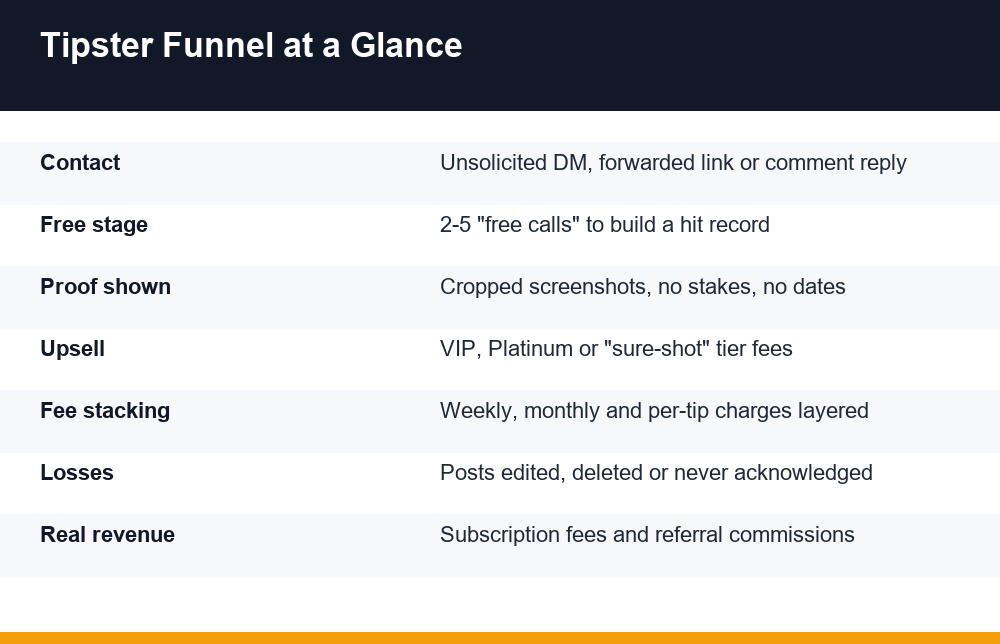
The funnel is remarkably consistent across channels, languages and sports. Recognising which stage you are standing in is more useful than trying to judge whether any individual call was good.
| Stage | What you see | What it is doing |
|---|---|---|
| Contact | Unsolicited message, invite link or reply | Moves you into a space the seller controls |
| Free calls | Two to five tips, some of which land | Builds an unverifiable hit record |
| Social proof | Screenshots, member congratulations, follower counts | Supplies emotional evidence instead of data |
| Scarcity | “Only 20 VIP slots”, countdown, closing soon | Compresses your decision time |
| First fee | Small entry price, often framed as refundable | Converts you from reader to customer |
| Fee stacking | Platinum tier, per-tip charges, “confirmation” fees | Extracts more from an already-committed buyer |
| Loss handling | Edited posts, blame on “late entry”, silence | Protects the record so the cycle can repeat |
| Exit | Rebranded channel, new name, same material | Resets the history and starts again |
The final row matters more than it looks. A channel that has accumulated too many visible complaints does not get repaired – it gets abandoned, and the same operator opens a fresh one with a clean history. That is why channel age, follower counts and pinned testimonials tell you almost nothing about reliability.
The same funnel shape turns up well outside sports, which is a strong hint that it is a sales structure rather than anything to do with analysis. Anyone who has watched the mechanics behind how colour prediction groups on Telegram are organised will recognise every stage in the table above, with the sport simply swapped out.
Why Nobody Can Sell Certainty in a Negative-Margin Market
Set aside the behaviour of sellers for a moment and look at the arithmetic they are operating inside. Prices on any market are set with a built-in margin, meaning the implied probabilities across all outcomes add up to more than one hundred per cent. That gap is the operator’s cut, and it is charged on every settled bet regardless of who placed it or why.
The consequence is that the expected value of a bet is negative before any opinion is applied. A forecaster would have to be accurate enough to overcome that margin consistently, across many events, after costs. Suppose for argument that someone genuinely could. Selling that edge to a growing subscriber base is the fastest way to destroy it: concentrated money moves prices, the price moves against the call before most subscribers can act, and the edge evaporates. Any real advantage is worth more used privately than sold at a monthly fee.
This is why the business model and the claim contradict each other. A seller of certainty would not need customers. The existence of a subscription fee is itself evidence that the revenue comes from subscriptions rather than from the forecasts, and that single observation is enough to see through most betting tipster scams without examining a single tip.
The deeper version of this argument – why staking plans, progressions and “low-risk” formulas all collapse against the same margin – is worked through in detail in our breakdown of why betting systems fail over the long run. The short form: no arrangement of bets changes the sign of a negative expectation.
None of this requires believing that every tipster is dishonest. Some are sincere and simply wrong about their own record, because they are measuring it the same unreliable way their audience is – from memory, from the posts that stayed up, and with the losses rounded down to near misses.
The 9 Red Flags Checklist
Each of these is visible before money changes hands. One alone is a caution; three together is a settled answer.
- Guarantees of any kind. “Sure shot”, “100% confirmed”, “fixed”, “no-loss” – certainty language in a probabilistic market is the single clearest signal.
- Screenshots as the only evidence. No dated, complete, independently held record of every call, win and loss.
- Editable history. Posts can be edited or deleted by the admin, and some clearly have been.
- Stake and odds hidden. Profit claims shown as big numbers with no mention of what was risked to produce them.
- Artificial scarcity. Limited slots, closing tonight, price rising at midnight – pressure applied to your decision timeline rather than to the quality of the information.
- Fee stacking. After the first payment, new tiers and per-tip charges appear that were never mentioned in the pitch.
- Payment to a personal account. Requests to pay an individual, a changing set of handles, or by irreversible transfer, with no invoice or stated refund terms.
- Loss blamed on you. Missed calls explained as your late entry, your wrong stake, your failure to follow instructions exactly.
- Push toward a specific place to play. A referral link, a code, or insistence that the tips only work on one named platform.
The last flag on the list deserves emphasis too, because it reveals where the money actually is. A forecast does not depend on where a bet is placed, so insistence on one destination means the seller is being paid for the referral. If the destination is an app sideloaded from a link rather than reached normally, you are now exposed to a second and unrelated set of problems; the warning signs there are collected in our rundown of how fake betting apps are built and distributed.
Why Tipster Channels Delete Their Losing Tips
Because the record is the product. A channel is not selling analysis, it is selling the impression of a hit rate, and that impression is maintained by editing rather than by accuracy. Deletion is the cheapest possible way to raise an apparent strike rate from roughly coin-flip to near-perfect.
Several variations of the same technique show up:
- Silent removal. The losing post simply is not there the next morning, and nobody who was not looking for it notices.
- Edit in place. Messaging apps allow post editing, so the selection is changed after the result is known and the post keeps its original timestamp.
- Both-sides posting. Different segments of the audience are sent opposing calls on the same event, so whichever way it goes, one group has a genuine screenshot to celebrate.
- Retrospective conditions. A call that lost is reframed as having been “only for VIP members”, “below minimum confidence”, or voided for a reason announced after settlement.
- Channel reset. When the complaints outgrow the celebrations, the channel is renamed or replaced and the history starts clean.
This is survivorship bias manufactured on purpose. You are shown the survivors and the casualties are removed from the sample, which is why a channel’s visible history can look extraordinary while the actual results of following it were ordinary or worse. It is also why asking a channel for its full record is such a useful test: the request is reasonable, it costs an honest operator nothing, and in practice it is met with deflection.
The both-sides variation is the one that most often convinces people, because the screenshot it produces is completely genuine. Nothing has been faked. A member really was sent that call, really did follow it, and really did win. What has been hidden is that an equal number of members were sent the opposite call on the same event, and their messages are not the ones being forwarded to you. The testimonial is true and the implication is false at the same time, which is why testimonials are the weakest form of evidence available here.
Keep your own log if you are unsure. Write down every call as it is posted, with the date and the price, before results are known. A fortnight of independent record-keeping is more informative than any amount of pinned testimonial, and it is the one piece of evidence the seller cannot edit. It is also worth doing on paper rather than in the channel, because a log that lives inside the thing you are measuring is not independent of it.
Why Big-Win Screenshots Prove Nothing At All
A screenshot is an image. It carries no verification of when it was made, whose account it shows, whether the figures are real, or whether the bet was ever placed. Treating one as proof is the error that nearly every version of these schemes is built on, and it persists because the image is emotionally vivid in a way that a spreadsheet is not.
The specific ways win screenshots mislead are worth naming plainly. Images are trivially edited, and the numbers in them are just text. Many platforms offer practice or demo balances that produce entirely genuine-looking screens with no money involved. A crop can remove the stake, the date, the account name, or the long column of losing entries directly above the winner. The same handful of images circulate between unrelated channels for years. And a real, unedited screenshot of one large win is still meaningless without the hundred losses that may have preceded it – the denominator problem again.
There is also a selection effect that requires no dishonesty whatsoever. In a group of several thousand members placing bets, someone will win big this week purely by chance. That person posts their screenshot, the channel amplifies it, and the thousands who lost say nothing. The feed you read is assembled almost entirely from the lucky tail of a distribution, and it will look like a winning channel even if the calls were generated at random.
The practical rule is simple: an image is a claim, not evidence. Nothing a channel can post to you is verifiable, which means the only reliable inputs are your own records and the structural facts about the market itself.
How Telegram Prediction Groups Actually Make Their Money
Following the revenue is the quickest way to understand the behaviour. None of these channels earn from being right, and understanding where the income does come from explains every design choice in the funnel.
Subscription and tier fees are the visible layer – an entry price, then a higher tier, then a premium tier above that, often with per-call charges bolted on for selections described as especially strong. Referral commissions are the layer underneath, paid when a member signs up somewhere through the channel’s link, which is why there is so often one specific destination being pushed. Some channels also monetise the member list itself, selling or reusing contact details for unrelated offers, which is why joining one tends to produce messages from others you never approached.
Two things follow from this structure. First, the channel’s incentive is volume of paying members, not accuracy, and those two goals are not merely different – they actively conflict, because accuracy claims that can be checked are worse for sales than claims that cannot. Second, a losing member is not a lost customer. The standard response to a bad run is an upsell: the losses are attributed to being on the wrong tier, and the remedy offered is a bigger payment. That loop is the whole business, and it is the reason betting tipster scams can run profitably for years while the people inside them lose steadily.
It also explains the recruitment pressure placed on members. Asking existing subscribers to invite friends converts your social credibility into the channel’s acquisition channel at zero cost, and it is usually framed as a bonus or a free week rather than as what it is.
What To Do If You Have Already Paid a Tipster
The most common reaction is to keep paying, because stopping means accepting that the earlier payments were wasted. That instinct is exactly what the fee-stacking stage is built to exploit. Money already spent is gone either way, and it should play no part in the decision about the next payment.
- Stop any recurring payment at the source, rather than relying on a cancellation request inside the channel.
- Save the evidence before you leave. Export the chat, screenshot the pitch, the fee messages and the payment confirmations while you still have access – admins remove members and wipe history quickly.
- Do not accept a recovery offer. Anyone who contacts you promising to retrieve lost money for an upfront fee is running the second half of the same scheme, and the approach often comes from the original operator.
- Leave and block, without negotiating. There is no version of the conversation that ends with the channel admitting the record was edited.
- Treat chasing as the signal it is. Increasing stakes to recover a loss is the point at which the money stops being the main problem.
- Talk to someone outside it. Explaining the sequence out loud to one person who is not in the channel breaks the private logic faster than anything else.
If the pattern has gone past money and into secrecy, sleep, or borrowing to stay in, free and confidential support exists independently of any operator or channel – the free, confidential helpline run by the National Council on Problem Gambling is a reasonable neutral starting point, and it costs nothing to ask.
The honest conclusion of all this is unglamorous. There is no filtered list of trustworthy tipsters at the end of the checklist, because the problem is not that the market is full of bad sellers – it is that the product being sold cannot exist. A negative-expectation market does not contain a certainty to sell, which means every seller of one is, knowingly or not, selling the appearance of a record they control. Recognising the funnel is useful; recognising that the margin is the whole story is better.
Frequently Asked Questions
Are paid betting tipsters worth it?
No, and the reason is structural rather than a matter of finding a better seller. Prices carry a built-in margin that makes expected value negative before any opinion is applied, and a subscription fee is an additional cost layered on top of that. A forecaster with a genuine edge would also destroy it by selling it, since concentrated subscriber money moves prices before most members can act. The existence of the fee is itself the clearest evidence that the revenue comes from subscriptions, not from the forecasts.
How do Telegram betting prediction groups make money?
From three sources, none of which is accuracy. Tier and subscription fees are the visible layer, often stacked as entry, premium and per-call charges. Referral commissions sit underneath, paid when members sign up somewhere through the channel’s link, which is why one destination is usually pushed hard. Some channels also monetise the member list itself. Because losses are answered with upsells rather than refunds, a losing member remains a paying customer.
Why do tipster channels delete their losing tips?
Because the apparent record is the product being sold, and deleting is far cheaper than being right. Messaging apps let admins remove or edit posts after results are known, so a roughly coin-flip strike rate can be presented as near-perfect. Variations include editing a selection in place, posting opposite calls to different segments so one group always has a genuine win to screenshot, voiding losses retrospectively, and renaming the channel when complaints accumulate. The result is survivorship bias created deliberately.
Can anyone really guarantee a winning bet?
No. Outcomes are uncertain and the market is priced with a margin that applies to every settled bet, so guarantees of any kind are incompatible with how the market works. Certainty language – sure shot, confirmed, fixed, no-loss – is a sales device, not a description of information. Anyone genuinely able to produce reliable profit would gain nothing by announcing it to a paying audience, because the advantage would disappear the moment the money concentrated.
What are the red flags of a fake tipster?
Guarantees or certainty language; screenshots offered as the only proof; a history the admin can edit or delete; profit claims with the stake and odds removed; artificial scarcity and countdowns; new fees appearing after the first payment; payment requested to a personal or shifting account with no refund terms; losses blamed on your timing or stake; and pressure toward one specific place to play, which indicates referral income. One is a caution, three together settle the matter.
Why do scam tipsters show screenshots of big wins?
Because an image is emotionally persuasive and carries no verification at all. Screenshots are easily edited, practice or demo balances produce genuine-looking screens with no real money involved, and a crop can hide the stake, the date or the losing entries above the winner. The same images circulate between unrelated channels for years. There is also a pure selection effect: in a group of thousands someone wins big by chance every week, posts it, and the thousands who lost stay silent.