Most people meet cricket id withdrawal problems at the worst possible moment: the balance on screen looks real, the withdrawal button has been pressed, and then nothing moves. The deposit cleared in seconds a week earlier. The payout has been “processing” for three days. A contact who used to reply instantly now answers once a day with the same sentence. Nothing about that pattern is unusual, and nothing about it is accidental either.
Money coming in and money going out are handled by very different parts of a platform, and the gap between how fast one works and how slow the other works is one of the most reliable signals a user ever gets. What follows sets out what that gap looks like, which signs appear before the money is stuck, and which records are worth collecting while you still can.
Table of Contents
The Payout Moment Is Where the Problem Shows Up
A deposit is a platform’s easiest transaction. It wants the money in, so the route is short, automated and almost always instant. A withdrawal is the opposite: it is the only point where value leaves, and therefore the only point where real behaviour becomes visible. Everything before it — the fast signup, the responsive chat, the clean interface, the credited bonus — costs nothing to provide and tells you almost nothing.
This is why so many users describe the same timeline. Weeks of smooth activity, then a single payout request that triggers questions nobody asked at signup. The account that needed only a phone number to open suddenly needs documents. The chat that answered in thirty seconds now escalates to a “finance team” with no name and no timeline.
Genuine friction and manufactured friction look identical for the first day or two. Payment rails do fail, banks do hold transfers, and checks on new accounts do take time. What separates the two is not the first delay — it is what happens next. Real friction resolves and produces a specific reason. Manufactured friction escalates, and each new stage asks for something more: a document, a fee, another deposit, more patience.
It is also worth being precise about what a pending balance is. On most of these setups it is a number rendered in an interface someone else controls, not a claim you can inspect. Your own bank or UPI statement shows what left your account; it shows nothing about what the other side is holding, or whether anything is being held at all.
That distinction is the whole subject here: not whether a delay happened, but whether it grows a new condition every time you satisfy the last one. The way a platform describes its account tiers and the limits attached to them is often the earliest honest look you get at how it intends to handle money going out.
The Payout-Trap Sequence, Step by Step
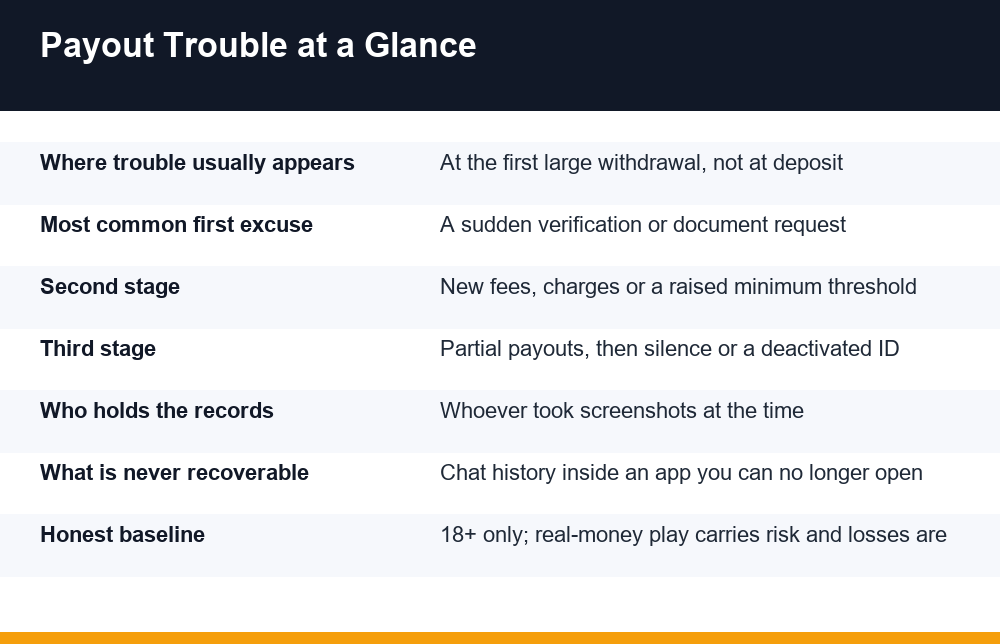
The sequence behind most cricket id withdrawal problems is consistent enough to describe step by step. It is not clever. It works because each step sounds reasonable on its own, and because the user has already committed money by the time step one arrives.
- Smooth onboarding. The ID is issued fast, often over a messaging app, with minimal information requested. Deposits credit instantly. Nothing is asked that might slow the first payment in.
- Normal activity, small cash-outs allowed. Modest withdrawals clear without comment. This establishes trust and gives the user a story to tell themselves and others: it paid before.
- The first significant withdrawal request. The amount is larger than anything previously taken out. Processing begins, and then stops.
- Sudden verification. Documents are requested that were never needed to deposit. Each submission is followed by a new objection — wrong format, unclear image, name mismatch, resubmit.
- New costs appear. A processing charge, a clearance payment, a gateway fee, a release deduction. Often the user is asked to pay it separately rather than have it taken from the pending balance.
- A threshold moves. The minimum withdrawal is now higher than the balance, or a turnover requirement surfaces that was not visible before, or a bonus is retroactively declared to have locked the funds.
- Partial payment, or silence. A fraction may be released to keep the user engaged and paying fees. Then the account is restricted, the ID is deactivated, the group is deleted, or the contact stops replying.
Two details matter more than the rest. The first is step five: a request to send money in order to receive money. There is no ordinary payment process in which the recipient funds the transfer out of pocket while a larger balance sits pending. If a charge is real, it comes off the amount being paid. The second is step six: a rule that appears after the request rather than before it. Terms that change shape when you try to use them are not terms.
The order is not fixed and not every case includes all seven stages. Some skip the small cash-outs. Some run four and five together, so a document objection and a fee request arrive in one message. What stays constant is the direction of travel: every stage after the request moves something from the user toward the platform — time, documents, money — and nothing moves the other way.
The sequence also explains why warnings arrive too late. By the time the pattern is obvious, two or three fees have usually been paid and identity documents submitted, which raises the felt cost of walking away and makes each further request feel like the last hurdle.
Seven Warning Signs of Cricket ID Withdrawal Problems
These are the signals that tend to appear before money is stuck, not after. None proves anything on its own. Two or three together is a pattern worth taking seriously, and it is far cheaper to notice them early than to discover them at payout.
- Deposits are instant, withdrawals are “manual review”. A mismatch this large between the two directions is a design choice, not a technical limit.
- Identity checks appear only at cash-out. A platform that genuinely verifies users does it before accepting money, not when asked to return some.
- Any instruction to pay a fee from outside the balance. Clearance charges, release fees, gateway payments, unlock deposits — variations of one mechanic.
- Terms you cannot read as a fixed page. Rules relayed in a chat window can be rewritten in the next message. Rules on a stable page cannot.
- Payment details that change between transactions. Different recipient names, rotating accounts or new handles each week indicate accounts that do not stay open long.
- Support that exists only inside a messaging app. No records you control, no route that survives a block, and the whole channel can vanish in one tap.
- Pressure to deposit again while a withdrawal is pending. “Top up to activate the payout” reverses the direction of the transaction you actually requested.
The seventh sign does the most damage, because it is framed as help rather than a demand. A pending payout creates urgency, and urgency makes an extra deposit feel like a solution instead of a second loss. Once a platform has learned that urgency works on a particular user, the requests rarely stop at one.
Signs three and five describe the same underlying fragility. A setup that needs money sent to a fresh handle every few weeks is not running a payment system; it is running a series of short-lived accounts. The arrangement that makes incoming money hard to trace makes outgoing money easy to stall, and the user is the only party whose details stay the same throughout.
It is also worth noticing what is not on that list. A slow payout by itself is not evidence of anything. Weekend processing, bank cut-off times and genuine first-time checks all produce real delays with real explanations. The difference is that a real explanation stays the same when you ask twice, and it names a date rather than a mood.
Why Small Payouts Clear and Large Ones Stall
This is the question that confuses people most, and the mechanics are straightforward. Paying out small amounts is cheap advertising. A user who withdraws a modest sum tells friends, posts a screenshot, and raises their own deposit size because the platform has now “proved” itself. The small payout is an expense that buys trust and larger future deposits.
A large payout has none of those benefits. It is pure outflow, and it arrives from exactly the user a predatory setup least wants to pay: someone whose balance is worth the trouble of blocking. So the response changes. Instead of processing, the account meets review, verification, thresholds and fees — the sequence above.
The practical consequence is that “it paid me before” carries almost no information about whether it will pay now. Past small successes are not a track record; they are the part of the arrangement designed to look like one. Judging a platform by the payouts that cost it nothing is the most common mistake in this whole area.
Some setups pay reliably up to a quiet internal ceiling and stall consistently above it. Users below the ceiling report no issues and genuinely believe the complaints are exaggerated. Users above it report the full sequence. Both groups describe the same platform accurately, which is why public discussion of cricket id withdrawal problems is so contradictory — the people best placed to warn others are the smallest group, and everyone still below the ceiling is honestly reporting the part that works.
Sudden Verification Demands and What They Actually Do
Verification requests are the most effective stalling tool available, because refusing them looks unreasonable and complying costs the user something real. The mechanic is not the request itself but the loop: each document submitted produces a new objection, and the objections are built to be unfalsifiable.
The image is too blurry. Now the name does not match exactly. Now a different document is needed. Now the first has expired from their system and must be sent again. Each round resets the clock and is framed as the user’s error. No document ends the loop, because ending it was never the purpose.
The cost is not just time. Identity documents sent into a messaging chat with an unknown recipient are copies you no longer control, and they are useful to the recipient for reasons that have nothing to do with your withdrawal. Sending a government identity document to an anonymous contact to release a pending balance transfers something far more durable than the balance itself.
The structural tell is timing. A platform that cares about verification does it at the gate. One that discovers it needs verification precisely when money is leaving is using the word, not the process. This is a recurring feature of the lookalike apps and cloned interfaces covered in our breakdown of how fake betting apps are built and spotted, where the front end exists to make that stage feel like a normal step in a normal product.
Fees, Thresholds and the Shrinking Balance
Once a withdrawal is pending, the second lever is arithmetic, and this is where cricket id withdrawal problems stop being about delay and start being about subtraction. The balance is not refused — it is reduced, reclassified or locked behind a number. Because each deduction is small relative to the total, users accept several before noticing that the pending amount is no longer worth the fees already paid.
The table below separates charges with ordinary explanations from mechanics that have none. It is not a rulebook and not a verdict on any particular platform; it is about whether a charge behaves like a charge or like a condition.
| What you are told | What an ordinary process looks like | What should raise concern |
|---|---|---|
| A processing or transfer charge applies | A stated amount deducted from the payout itself, visible before you confirm | A charge you must pay separately, by fresh transfer, before the payout moves |
| Your withdrawal is below the minimum | A minimum published in advance and unchanged by your request | A minimum that rises after your request, or appears for the first time at payout |
| A deduction is pending before release | Shown as a line item on the payout, with the net amount stated | A sum collected from you up front, by cash or UPI, with nothing issued in return |
| A turnover requirement is unmet | A bonus condition disclosed when the bonus was credited | A requirement discovered only when you try to cash out your own deposits |
| Your payment method must be re-enabled | A one-time check that resolves and does not repeat | A repeated unlock, reactivation or gateway fee each time you ask |
| Part of the amount has been released | The remainder arrives on a stated date and does arrive | A partial payment followed by a new fee to release the rest |
The pattern across the right-hand column is one idea: money must flow toward the platform before money flows away from it. Any mechanic with that shape is worth treating as the end of the relationship rather than a step within it. Paying one release fee almost never produces a release; it produces a second release fee, because the first payment proved the method works on you.
The amounts are chosen carefully. A release fee is usually a small fraction of the pending balance — large enough to be worth collecting, small enough that paying it feels obviously rational next to what is apparently waiting. That ratio is the persuasion, and it is why later requests tend to be larger.
There is a quieter version with no fees at all. The balance is reclassified — part becomes “bonus funds”, part becomes “locked promotional credit”, and the withdrawable portion shrinks to something not worth chasing. Nothing was refused. The number changed definition, and there is no page you can point to that says otherwise.
Deactivated IDs After a Deposit
The harshest version skips the sequence entirely. A deposit is made, the ID stops working, and the contact who issued it stops replying. The login fails, the app reports an error, or the account loads with a zero balance and no transaction history. The money was not lost at a game — it was never placed into anything at all.
This happens most often with IDs issued person-to-person: a username and password handed over in a chat, with deposits sent to a personal payment handle rather than through any identifiable checkout. The person issuing the ID controls the account, the balance figure and the ability to revoke access. Nothing about the arrangement requires them to keep any of it available.
There are recognisable variants. Deactivation immediately after an unusually large deposit. Deactivation after a win, framed as an investigation into “irregular activity” with no detail. Deactivation of the whole group or channel, so every user loses their contact point at once. And the mirror-image version, where the ID still works but the balance has been reset and the history is empty, leaving nothing on screen to point at. That last one leaves users most stuck, because there is no refusal to describe — only a disagreement about what a number used to say.
The recurring structural feature is that access was always held by someone else. If a third party can create an account for you, they can close it, and the balance you were reading was a number in their interface rather than a record you could check. That asymmetry is the whole risk, and it exists before any dispute begins. Whether access and records sit with you or with an intermediary matters more than any feature comparison; our breakdown of how different playing habits change what to look at when choosing an ID works through that selection stage in detail.
The Documentation Habit That Protects You
Almost every account of cricket id withdrawal problems has the same missing element: the evidence lived inside an app or chat the user no longer has access to. Screenshots taken at the time are the one asset that cannot be revoked remotely, and they cost nothing to collect. Building the habit before there is a dispute is the difference between a complaint with specifics and a complaint with a story.
The point is not to prepare for a fight. It is that unverifiable claims cannot be acted on by anyone — a bank, a payment provider, a reporting portal, or your own future self trying to remember what the balance said. Records turn “they took my money” into dates, amounts and reference numbers.
- Every transaction confirmation. Bank or UPI reference number, exact amount, timestamp, and the recipient name or handle as it actually appeared.
- The balance screen before and after. A full screenshot showing the figure, the date and the account identifier, not a crop of the number alone.
- The withdrawal request itself. Request ID, amount, the status shown at submission, and the stated processing time.
- Complete chat logs, exported where possible. Not selected screenshots — the whole thread, including where terms were explained verbally.
- Any page stating fees, minimums or conditions. Capture it when you read it; these pages are edited more often than users expect.
- Each fee request, verbatim. The exact wording, who sent it, and the payment details you were given.
- A simple running log. One line per event with a date. Memory reorders timelines; a log does not.
Store copies outside the device that holds the app — email them to yourself, or keep them in cloud storage. A phone is exactly the thing that gets reset, replaced or lost at the least convenient time, and app-internal history can disappear the moment an account is restricted.
One detail worth getting right is the recipient name on each transfer. Users remember the platform’s name; the bank statement remembers an unrelated individual or small business. That mismatch is often the most informative line in the whole record, and it is the one piece nobody on the other side can edit afterwards.
If money moved by payment transfer and you intend to report it, those records are exactly what official reporting routes ask for first: transaction reference, amount, date, recipient details. In India, online financial fraud can be reported through the national cybercrime reporting portal. Reporting early matters for a practical reason — the sooner a disputed transfer is flagged, the more chance there is that the funds have not already moved on through several accounts.
Mistakes to Avoid When a Payout Stalls
Once a withdrawal is pending and the answers have started to shift, the decisions that follow usually determine how much is lost. The common errors are not exotic; they are the natural responses to pressure, which is exactly why they are anticipated.
- Paying a fee to release funds. The most expensive mistake in the sequence. It confirms you will pay, and another request follows.
- Depositing again to “unlock” the balance. This converts a pending loss into a confirmed additional one.
- Sending identity documents into an anonymous chat. Once sent, they cannot be recalled, and they are useful well beyond your account.
- Deleting the chat out of frustration. That thread is your only record of what you were told and by whom.
- Waiting silently for weeks. Delay is the mechanic. Time spent being patient is time the other side is using.
- Trying to recover the amount by playing larger. No sequence of outcomes changes the fact that the problem is the payout route, not the size of the balance.
- Accepting a recovery offer from a stranger who contacts you. People who approach users with stuck balances and offer to retrieve them for a fee are running the same mechanic one layer out.
The last point deserves emphasis because it targets people who have already lost money and can least absorb another loss. Unsolicited offers of recovery, whether framed as agents, consultants or insiders, follow the fee-before-funds pattern exactly, and they arrive when the user is most willing to try anything. The arrival of such an offer is itself a signal, since it means the details of the stuck balance are circulating somewhere.
There is one quieter error: continuing elsewhere on the assumption that the problem was specific to one platform. These mechanics are not a property of a brand. They are a property of an arrangement in which someone else holds the account, the balance figure and the only copy of the terms. Changing the name at the top of that arrangement changes nothing that matters.
The broader takeaway is uncomfortable but useful. Cricket id withdrawal problems are rarely a malfunction that better handling would have avoided — they are usually a feature of how access and records were arranged before any money moved. The checks worth doing happen at the start: who holds the account, whether the terms exist as a page you can read, and whether you can see the money’s route in your own bank record rather than only in someone else’s interface. An honest note belongs here too: this is 18+ territory, real-money play carries risk, and losses are the expected outcome regardless of how smoothly any payout works.
Frequently Asked Questions
Why is my betting withdrawal taking so long?
Delays have both ordinary and concerning causes. Ordinary ones include bank cut-off times, weekend processing, a genuine first-time check, or a payment route that failed and must be retried — and these produce a specific reason that stays the same each time you ask. The concerning version escalates instead of resolving: a verification request, then a document objection, then a fee, then a threshold. The useful question is not how long the delay has lasted but whether each enquiry produces a new condition. If the explanation changes shape every time you follow it, the delay is the mechanism rather than a side effect of one.
What does it mean when an ID is deactivated after a deposit?
It usually means access to the account was never yours. When an ID is issued person-to-person over a chat and deposits go to a personal payment handle, the issuer controls the login, the balance figure and the ability to revoke it. Deactivation after a deposit or a win, often described as an investigation into irregular activity, means the money was not placed into anything you can inspect. The balance you were reading was a number in someone else’s interface, not an independent record, which is why your own bank or UPI transaction history becomes the only evidence that survives.
Are extra withdrawal fees a scam sign?
The fee itself is not the signal — its direction is. An ordinary charge is deducted from the payout and visible before you confirm, so your net amount is simply smaller. The pattern worth treating as an endpoint is a charge you must pay separately, by fresh transfer, before a larger pending balance will move. No ordinary payment process requires the recipient to fund the transfer out of pocket. Paying one such fee almost never releases the funds; it demonstrates that the method works on you and is followed by another request under a different name.
What records should I keep of betting transactions?
Keep every transaction confirmation with its bank or UPI reference number, exact amount, timestamp and the recipient name as it actually appeared. Add full screenshots of the balance screen before and after, the withdrawal request with its ID and stated processing time, complete exported chat logs rather than selected screenshots, any page stating fees or minimums at the moment you read it, the verbatim wording of every fee request, and a simple dated log of events. Store copies off the device that holds the app, because app history and chat threads disappear the moment an account is restricted.
Why do scam platforms pay small withdrawals but block big ones?
Because small payouts are cheap advertising and large ones are pure outflow. A user who successfully withdraws a modest sum tells other people, posts the screenshot, and raises their own deposit size because the platform appears proved. That expense buys trust and bigger future deposits. A large payout buys nothing and goes to exactly the user worth blocking. Some setups pay reliably up to a quiet internal ceiling and stall consistently above it, which is why users below the ceiling genuinely believe the complaints are exaggerated — both groups are describing the same platform accurately.