Colour prediction telegram groups promise something that cannot exist: advance knowledge of a result that has not been generated yet. The format is familiar — a channel with a large member count, a countdown, an admin posting RED or GREEN before the round closes, and a wall of congratulatory screenshots afterwards. What almost no page explains is that the people running these channels are paid the same whether members win or lose, and that the record you scroll through has been edited before you ever see it. This breakdown walks through the business model, the arithmetic underneath it, and the six specific reasons the arrangement works out badly for the member. It is not a case against one channel. It is a case against the category.
Table of Contents
Colour Prediction Telegram Groups Explained In One Short Answer
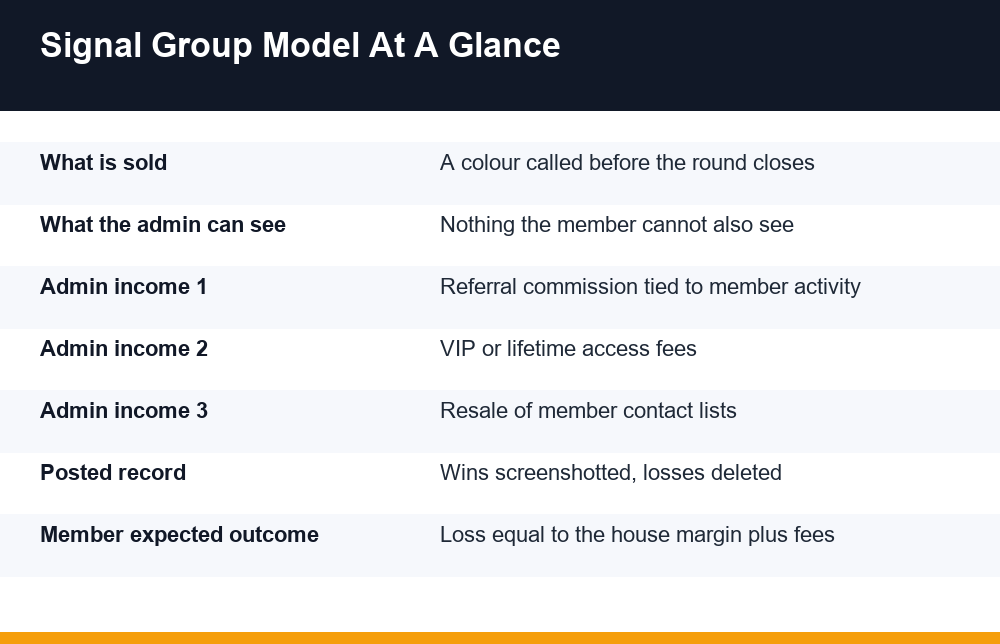
Colour prediction telegram groups are chat channels where an administrator posts a colour — usually red, green or violet — shortly before a round closes on a colour prediction app, and members are told to follow the call. Some are free and monetised another way. Some charge for VIP, premium or lifetime access. The short answer is the same for all of them: the outcome is produced by a server process after entries are locked, and nobody in the channel has sight of it. A call made before that moment is a statement of confidence, not information.
That single fact collapses the entire proposition. If the admin genuinely knew the result, the rational move would be to stake their own money quietly and scale it, not to build an audience, moderate a chat, answer questions at midnight and sell access for a monthly fee. The effort put into audience-building is itself the clearest signal in the room — it tells you where the actual revenue comes from.
It is worth separating two things that get blurred together. One is whether the app itself resolves rounds and pays out as described; that is a question about the platform, and it is not what this page is about. The other is whether a third party in a chat window can know the outcome before it exists. Those are different claims, and the second one fails on its own terms regardless of how the first is answered. A channel can be entirely sincere about its enthusiasm and still be selling nothing.
The rest of this breakdown is about why the illusion holds up so well despite that. The answer is partly design, partly arithmetic and partly the way human memory handles a scrolling feed. Each of those deserves its own section, because each one is doing real work in making a hollow product feel like a working one.
- What is advertised: accuracy, an edge, an inside read on the next round.
- What is delivered: a colour chosen from a very small set, posted before a result nobody can see.
- What is monetised: your sign-up, your access fee, your continued activity and your contact details.
- What is hidden: every round the call missed, removed or never posted at all.
How A Signal Channel Is Actually Assembled
The channels look organic and are usually anything but. A typical build starts with a channel name borrowed from a familiar app, a display picture suggesting a team of analysts, and a member count that cannot be audited from the outside. The early content is not calls at all — it is screenshots. Balance screenshots, withdrawal screenshots, a stack of green ticks. Only once the wall of proof is in place do the live calls begin, because the proof is what makes the first call credible.
Moderation is tight and one-directional. Members who post a loss are muted or removed, usually with a line about negativity or about having failed to follow instructions precisely. Members who post a win are pinned and praised. Within a short time the visible chat has been curated into a room where everybody appears to be winning, which is exactly the environment in which a new member stops asking the obvious questions.
The vocabulary is part of the construction too. Calls become signals, members become the team, a run of losses becomes a bad session, and the person posting becomes an analyst. None of those words add information, but each one borrows the shape of a professional setting and makes the arrangement feel like something other than a stranger naming a colour in a chat window.
The same template shows up across apps and languages because it is a template. If you have read our breakdown of how tipster channels manufacture a track record, the mechanics will look familiar — colour prediction simply strips the format down to its simplest possible form, because a colour needs no sporting knowledge to call and no expertise to defend.
There is a second layer worth naming. Many channels do not only sell access; they also hand members a referral link or code and ask them to register through it. That request is not hospitality. It is the point at which the admin’s income becomes attached to your activity, and it reframes everything posted afterwards.
Why A Signal For A Server-Generated Result Is Empty
Here is the structural problem, stated plainly. In this format, entries close and then the result is determined and published. Whatever process produces it runs on infrastructure that a channel admin has no access to, no visibility into and no influence over. There is no stream of pre-result data for them to read, so there is nothing for a signal to be derived from.
People reach for pattern language to fill the gap: the colour is due, violet is building up, the last four rounds set up the fifth. Independent rounds have no memory. A sequence of five reds changes the next round exactly as much as a sequence of five coin flips changes the next flip, which is to say not at all. Our longer piece on what actually determines a colour prediction round result walks through why period-number reading and trend charts are decoration rather than inputs.
The confusion is made worse by the small number of options. With roughly a two-way call on the main colours, an admin posting constantly will be visibly right about half the time without knowing anything whatsoever. Half of a very large number of calls is a very large number of correct calls — more than enough to fill a highlights feed indefinitely. Correctness at chance level looks identical to skill when you only ever see the correct half.
This is also why a channel can never be argued out of its position. Any single correct call is held up as confirmation; any single miss is absorbed as variance, or blamed on timing, or on the member entering late. A claim that is confirmed by hits and never damaged by misses is not a claim about the world at all. It is unfalsifiable by construction, and that property is a feature of the sales model rather than an accident of it.
And even in the imaginary case where a channel were right slightly more often than chance, the member’s return still has the platform’s margin taken out of every round. The margin is the part that does not move. It is the one number in the whole arrangement that is genuinely predictable, and it points one way.
How Prediction Group Admins Earn Money
This is the section most ranking pages skip, and it is the one that explains everything else. Admins of colour prediction telegram groups are not paid for accuracy. They are paid for volume, headcount and churn. Once you see the revenue lines separately, the behaviour of the channel stops being puzzling.
The first line is referral commission. The admin earns a cut tied to the registrations and the activity generated through their link. Member losses are not a failure of the arrangement; in a margin-based product, sustained member activity is the arrangement. The second line is access fees — VIP tiers, upgrade tiers, lifetime tiers, often sold with a deadline. The third line is the member list itself: a list of people demonstrably willing to pay for a promised edge is a resellable asset, and it gets resold, which is why one sign-up tends to produce invitations to several more channels.
Two further mechanics are worth naming because they are presented as generosity. A recovery or compensation offer, paid in channel credit rather than withdrawable money, keeps a losing member active instead of leaving. And a loss-recovery promise usually arrives attached to a larger access package, which converts your worst moment into their best sale.
| What the channel says | What the structure means |
|---|---|
| “Register with my code to receive signals” | Your registration and activity generate commission for the admin |
| “VIP members get the accurate calls” | The free tier exists to sell the paid tier, not to be accurate |
| “Join before the slots close tonight” | A deadline removes the time you would otherwise spend checking |
| “We will recover your loss next session” | A larger payment or deeper involvement is about to be proposed |
| “Our team has inside access” | An unverifiable claim about infrastructure nobody in the chat can reach |
| “Losses happen when you do not follow exactly” | Every miss is pre-assigned to member error rather than the call |
Notice what is missing from that list of income lines: any payment that depends on members finishing ahead. There is no tier that pays the admin more when the room does well, and no mechanism by which a losing member costs the channel anything. Where an incentive is absent, you should not expect the behaviour it would have produced.
None of this requires the admin to be unusually cynical. It only requires the incentives to point where they point. A person whose income is attached to your continued play has no mechanism by which to tell you to stop, and no financial reason to post the rounds they got wrong.
The Screenshot Trick: Survivorship Bias In One Scroll
Survivorship bias is the quiet engine of the whole format, and it is worth understanding properly because it is the thing that makes an empty product feel evidenced. A channel does not need to fake a single screenshot to produce a flawless record. It only needs to choose which real ones to post.
Run the arithmetic. Suppose an admin posts forty calls in a day across several sub-channels. Roughly twenty land. Those twenty get screenshotted, captioned and pinned. The other twenty are deleted, or were posted to a channel that is now archived, or are reframed as a session members were told to sit out. What a new member scrolls through is twenty consecutive wins — a record that is factually accurate, verifiable, and completely meaningless as evidence of skill.
The same trick scales across channels rather than within one. Run eight channels, each calling a different colour on the same round, and at least one of them produces a long unbroken streak purely by elimination. That channel becomes the flagship. The others are quietly retired. This is why streak claims should be read as a statement about how many channels were started, not about how good any one of them is.
- Ask for the full unedited call history, timestamped, including every miss.
- Check whether the channel’s message history has been cleared or the channel recreated recently.
- Note whether losing rounds are ever discussed at all, by anyone, in any thread.
- Watch whether members who report losses stay in the chat or disappear from it.
- Compare the pinned streak against the channel’s actual creation date.
Almost no channel survives step one. The request is usually met with a rule about not sharing records outside VIP, or with removal — and that response is itself the answer. A record that would withstand inspection would be published, because it would be the single best marketing asset the channel could own.
The effect is strongest on a new member precisely because a feed is read in one direction. You see what was kept, in the order it was kept, with no marker where anything was removed. Nothing about the interface tells you that you are looking at a selection rather than a history, and that absence does more persuasive work than any claim the admin makes in words.
Recovery Plans, Doubling And The Margin That Does Not Move
Sooner or later a channel will introduce a recovery structure: a sequence of escalating entries presented as a way to turn a run of losses back into a profit. It is sold as discipline, mathematics, or a method the serious members use. It deserves a flat statement rather than a debate, and we are not going to describe how to operate one. The structural point is the only part that matters.
Escalating sequences do not change the probability of any round, because the rounds are independent. What they change is the size of the loss when the run goes against you, and runs go against everyone eventually. Each round still has the platform’s margin removed from it, and a sequence of rounds removes the margin repeatedly rather than once. Spreading a wager across a chain does not dilute a margin; it applies it more times.
There is also a hard ceiling that marketing never mentions. Every escalating sequence collapses the moment the required amount exceeds the money available or the platform’s per-round limit, and that threshold arrives far sooner than people expect. The sequence does not fail rarely at the end; it fails predictably, at a known point, and the failure is large by construction.
What makes the structure persuasive is that its early stages feel like evidence. A short chain that recovers reads as proof the method works, and that will happen often, because short chains usually do resolve. The rare long chain is the one that carries the entire loss, and it is invisible until it arrives. A method that works most of the time and fails catastrophically the rest of the time is not a method that works most of the time.
Our reader-submitted account of what a strategy follower actually experienced over several weeks covers the same ground from the inside: the early rounds confirmed the method, the chain eventually ran past what was available, and the recovery promised in the channel never materialised. That shape repeats because it is the shape the arithmetic dictates, not because of bad luck. No system beats the margin — that is the house position of this site, and it is not a matter of execution or discipline.
Red Flags Checklist Before You Join Any Channel
If you are weighing up an invitation, the useful question is not whether the channel seems accurate. Accuracy claims are unfalsifiable from the outside by design. The useful question is what the person on the other end is paid for. These markers answer that question quickly.
- A referral link or code is required to receive calls. This attaches the admin’s income to your activity before a single call is made.
- An access fee is charged for “more accurate” calls. Accuracy is not a tier; if the free calls are not accurate, the paid ones are not either.
- Losses are never visible. Not in the feed, not in the chat, not in the pinned record.
- Members who report losses are removed or muted. The room has been curated, so what you see is not a sample.
- Deadlines and limited slots. Urgency exists to remove the interval in which you would check things.
- Payment requested to a personal account or wallet. Routed outside any process, with no record you can point to afterwards.
- Screenshots as the primary evidence. An image shows one round, not that a method exists.
- A promise to recover previous losses. Reliably the prelude to a larger request.
- Claims of inside or admin access. Unverifiable by construction, and the claim is doing the persuading.
- Pressure to recruit friends or family. Your network is being converted into the admin’s commission base.
A quick way to use that list: count how many of the markers are present before you look at a single call. If more than two or three are there, nothing you see in the feed afterwards will tell you much, because the feed is the part of the channel most under the admin’s control. The structure is observable from the outside. The accuracy is not.
One more marker sits outside the list because it is about you rather than the channel. If you find yourself checking the feed between rounds, calculating what the next entry needs to be, or feeling that stopping now would waste what has already gone in, the arrangement has stopped being entertainment. GamCare publishes free, non-commercial information and support for people affected by gambling harm that is worth reading away from the channel, with the notifications off.
Real-money play is for adults only, carries real risk, and losses are the expected outcome rather than the unlucky one. That is the honest baseline that colour prediction telegram groups are built to obscure, and it does not change regardless of how convincing the screenshots look.
Colour Prediction Telegram Groups: Questions Answered
The five questions below are the ones readers send most often about colour prediction telegram groups. They are answered the same way the rest of this breakdown is: by looking at who gets paid and when, rather than at how confident the posts sound.
Do colour prediction Telegram groups really work?
No. The result is generated after entries close, on infrastructure no channel member can see, so there is no information for a call to be based on. Apparent accuracy comes from a small set of options and an edited record, not from a method. Over any real number of rounds the margin is the only reliable outcome.
How do prediction group admins earn money?
From referral commission tied to your registration and activity, from access and VIP fees, and from reselling the member list to other channels. All three pay out whether members win or lose, which is why nothing in the channel’s incentive structure points toward your result.
Why do signal groups post only winning screenshots?
Because selection is cheaper and more convincing than fabrication. Posting the roughly half of calls that land and deleting the rest produces a perfect record made entirely of genuine screenshots. Running several channels on opposite calls produces the same effect across channels — one survives with a long streak, the others are retired.
Can a VIP group know the next colour result?
No. Paying more does not create access that does not exist. The VIP tier is a price point, not a data source; the free tier exists to establish credibility and sell the paid one. If genuine advance knowledge existed, selling it to strangers for a monthly fee would be the least profitable possible use of it.
Why do prediction groups push referral codes?
Because the code is how your activity is attributed to the admin for commission. It is usually the first thing requested and the one condition that is never flexible, which tells you where the channel’s revenue actually sits. Once the code is in place, every later message is coming from someone paid by your continued play.
Frequently Asked Questions
Do colour prediction Telegram groups really work?
No. The result is generated after entries close, on infrastructure no channel member can see, so there is nothing for a call to be based on. Apparent accuracy comes from a very small set of options combined with an edited record, not from a method. Over any real number of rounds, the platform’s margin is the only reliable outcome.
How do prediction group admins earn money?
From referral commission tied to your registration and activity, from VIP or lifetime access fees, and from reselling the member list to other channels. All three income lines pay out whether members win or lose, so nothing in the admin’s incentives points toward your result.
Why do signal groups post only winning screenshots?
Because selection is cheaper and more convincing than fabrication. Posting the roughly half of calls that land and deleting the rest produces a flawless record built entirely from genuine screenshots. Running several channels on opposing calls achieves the same thing at scale: one survives with a long streak and the others are quietly retired.
Can a VIP group know the next colour result?
No. Paying more does not create access that does not exist. The VIP tier is a price point rather than a data source, and the free tier exists to build credibility and sell the paid one. If real advance knowledge existed, selling it to strangers for a monthly fee would be the least profitable possible use of it.
Why do prediction groups push referral codes?
Because the code is how your activity is attributed to the admin for commission payment. It is typically the first thing asked for and the one condition that is never negotiable, which shows where the channel’s revenue actually sits. After the code is in place, every message you read comes from someone paid by your continued play.