Chasing losses in betting is the decision to place another stake mainly because the last one lost, and it is among the most expensive habits in recreational gambling. It almost never feels like a decision at the time. It feels like correcting a clerical error — as though the money is still out there, sitting just behind one more result. This breakdown covers what is actually happening in those minutes, why the arithmetic never forgives the attempt, and which interrupts reliably stop the sequence before it becomes a long night. No systems, no picks, no promises. 18+. Real-money play carries risk, and losses are the expected outcome over time.
Table of Contents
Chasing Losses in Betting: The Short Answer
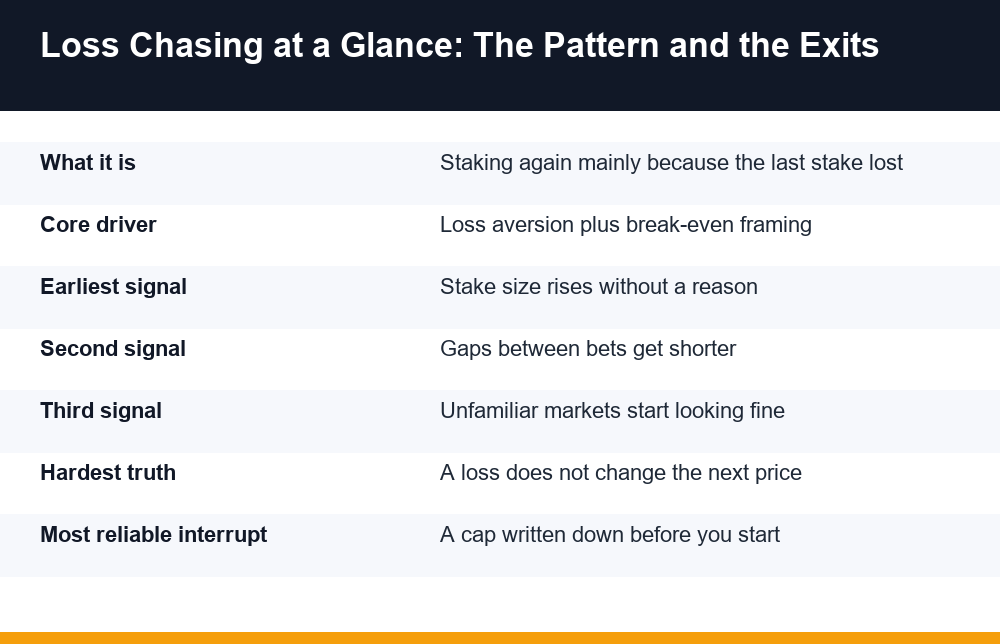
The short answer is this: stop at a number you fixed before you started, not at a number that feels fair once you are down. Chasing losses in betting takes hold because a loss quietly changes the goal. You began the session wanting entertainment, or a small win, or an hour of distraction. After three losses you want something completely different — you want to get back to level. Those are not the same objective, and the second one has no natural stopping point other than zero or an empty account.
That goal swap is the whole mechanism. Everything else — rising stakes, shrinking gaps between bets, markets you would never normally touch — is downstream of it. And the thing that makes it so hard to argue with in the moment is that getting back to level sounds modest. It sounds like the opposite of greed. It sounds like responsibility. It is neither; it is just a target that happens to sit behind an unknown number of further losses.
The hard fact underneath it: nothing about a loss changes the price of the next bet. A market does not owe you anything and has no memory of your afternoon. The next line is priced the same whether you are up, level or four down. Your losses are information about the past and nothing else. That is unsatisfying, which is precisely why the mind reaches for a more comfortable story instead.
It is also worth separating the chase from a losing run. A losing run is an outcome, and on its own it tells you very little. The chase is a change in how you are deciding — the deficit, rather than the bet in front of you, becomes the reason you act. One of those is weather. The other is a steering problem, and only the second is in your hands.
The pattern has a recognisable signature, and learning it is more useful than any amount of willpower, because you can spot a signature from outside your own head:
- Stake size rises with no reason that existed an hour ago — the increase is justified by the deficit, not by the bet.
- The gap between bets gets shorter. Research time collapses. Markets get picked because they start soon.
- Unfamiliar markets start looking acceptable — obscure leagues, odd props, anything with a short settlement time.
- Time stops registering. You could not say within half an hour how long you have been at it.
- You start calculating backwards — working out what stake would clear the hole, then finding a bet to fit it.
- Relief, not interest, is the feeling you are after. A win would not be fun; it would be a reprieve.
Three or more of those at once is not a bad run. It is a different activity with the same name.
Why the Urge Feels Rational in the Moment
Any honest account of chasing losses in betting has to start by admitting that the urge is not stupid. It is built out of reasoning that works perfectly well almost everywhere else in life. If you drop a tool behind a shelf, persistence pays. If a job is half done, finishing is usually the right call. Effort applied to a problem normally moves the problem. Betting is one of the few domains where that instinct is actively inverted, and nothing in ordinary experience prepares anyone for that.
Then there is the sunk-cost reflex. Money already lost reads as invested rather than gone, so walking away feels like wasting it — as though stopping is what makes the loss real. In truth the loss became real at settlement. Stopping does not create it; stopping just stops adding to it. But the mind files an open session differently from a closed one, and an open session feels recoverable.
Break-even framing does the rest of the work. Zero is a magnetic number. Being down a modest amount and being level are psychologically miles apart even when the practical difference is trivial. People will take a genuinely bad risk to touch zero that they would never take to go from zero to a profit of the same size. That asymmetry is not a character flaw. It is a well-documented feature of how people weigh gains against losses, and it has been understood for a long time by anyone whose income depends on it.
Intermittent wins keep the loop turning. Because wins arrive unpredictably rather than on a schedule, a run of losses never carries a clear signal that the run will continue. Every loss leaves the next result open, and that open possibility is the engine. Reinforcement arriving at irregular intervals is unusually persistent, which is why the behaviour tends to outlast any belief that it will actually work.
Finally, the moment is loud. There is a timer, a settlement, a near miss, a notification, a balance in large type. None of that helps anybody think slowly. The surroundings are arranged so that the next decision happens fast, and fast decisions taken straight after a loss are very often the chase.
The Psychology: Loss Aversion and the Almost-Even Illusion
Underneath the behaviour sit three well-studied mechanisms. None of them is exotic, and knowing their names genuinely helps, because a named effect is easier to notice than a vague mood.
Loss aversion: the deficit is louder than the win
A loss of a given size tends to register more strongly than a win of the same size. That imbalance means a down session generates far more pressure to act than an up session generates pressure to stop. It is why people who would happily leave a small profit on the table cannot leave an equivalent small deficit alone. The deficit has a voice; the profit does not.
The almost-even illusion
This is the quiet one, and it does the most damage. Once you are down, you begin measuring every bet against the hole rather than against reality. A result that recovers part of the deficit feels like progress even when the session total is still deeply negative — and a result that gets you close to level feels like near-success, which is one of the strongest signals in the whole arrangement. A near miss registers as encouragement while costing exactly what a loss costs. That combination keeps people seated far longer than any realistic win rate would justify.
Mental accounting: the session purse that is not real
People instinctively treat a session balance as a separate pot with its own rules, distinct from rent money or savings. Winnings staked back get described as playing with their money, as though a different currency were involved. It is all the same money, and the moment the session purse becomes fictional, the real limits become invisible too. This is the same accounting slip that fuels the bankroll traps built into fast-cycle prediction products, where the loop is short enough that the purse is re-imagined dozens of times an hour.
Put the three together and you have a reasonably complete explanation. The deficit shouts, the near misses promise, and the money stops feeling like money. There is no need to invoke weakness or stupidity anywhere in that chain, which matters, because people who think of the chase as a moral failing tend to hide it — and hiding it is what lets it grow.
What Actually Happens to the Money
The most common defence of chasing losses in betting is arithmetical: if you increase the stake enough, one win clears everything. That is technically true for the win and completely false for the sequence, and the gap between those two statements is where accounts disappear. The table below is not a method and should not be read as one — it is the reason that every version of the method fails. It assumes a flat doubling from a starting stake of 100 units.
| Losses so far | Total already staked | Next stake needed | Exposure if it also loses |
|---|---|---|---|
| 1 | 100 | 200 | 300 |
| 2 | 300 | 400 | 700 |
| 3 | 700 | 800 | 1,500 |
| 4 | 1,500 | 1,600 | 3,100 |
| 5 | 3,100 | 3,200 | 6,300 |
| 6 | 6,300 | 6,400 | 12,700 |
| 7 | 12,700 | 12,800 | 25,500 |
Two things stand out. The first is how fast the required stake outgrows anything a recreational player would call a normal bet — after five losses the next stake is thirty-two times the opening one. The second is subtler and worse: the best possible outcome of the entire sequence is getting back to zero. You accept escalating exposure for a ceiling of break-even, which is close to the poorest risk-to-reward shape a run of bets can have. It is the shape every chase takes, whether the escalation is formalised or improvised.
There is a further problem the table cannot show, which is that the sequence is not actually completable. Escalation runs into real ceilings long before the arithmetic runs out — the money in the account, the maximum stake a market will accept, the practical limits on how much can be moved in a day. A doubling plan only works if it can always double once more, and it never can. The point at which it stops being able to is the point at which the whole accumulated exposure lands at once.
In practice the escalation is messier than the table. People do not double cleanly; they jump, hesitate, jump harder, then take a wild swing at a market they do not understand. The messiness hides the trajectory, which is why writing figures down beats carrying them in your head. A written ledger makes the curve visible while it is still shallow.
There is also a second cost that never shows in any table: the next session. A chase that ends badly tends to open the following day already down, already with a target, already compromised. The deficit carries forward psychologically even when the ledger resets. That is how a single bad evening becomes a bad month.
Eight Interrupts That Break the Cycle
Advice about chasing losses in betting usually stops at know your limits, which is roughly as actionable as telling someone to be taller. What follows are eight concrete interrupts. They work because each one inserts friction or a decision point at a moment when the chase depends on there being none. Pick two or three rather than all eight — a rule you actually follow beats a system you admire.
- Write the number down before you open anything. One figure, on paper or in a note, with a date. The act of writing converts a vague intention into a commitment you have to actively break rather than passively drift past.
- Set a time cap as well as a money cap. Time runs out before money does in most sessions that end badly. A clock alarm in another room is better than a phone timer you can dismiss without standing up.
- Record each loss in words, not just figures. Writing lost 400, third in a row, I want it back forces the motive into daylight. Naming the motive is often enough to deflate it.
- Make the device the barrier. Close the app, lock the screen, put the phone in another room. Physical distance costs nothing and buys the only thing you need, which is a few minutes.
- Install a mandatory pause after any loss that stings. Ten minutes, no exceptions, and no exceptions for live markets especially. Most chases die in the first ten minutes of nothing happening.
- Never resize a stake while a session is in progress. Decide stake size cold, in advance, and treat mid-session changes as off-limits in both directions. This single rule removes the chase’s main instrument.
- Keep betting money physically separate from everything else. A separate pot with a fixed top-up schedule means running out is an event rather than a rounding adjustment on your main balance.
- Tell one person the number. Not a confession, just a figure said out loud to someone who will remember it. External accountability costs nothing and is remarkably hard to argue with at 1 a.m.
Notice what is absent from that list. There is no advice about which bets to place, how to adjust stakes to recover, or when the odds are in your favour. That is deliberate. The chase is not a selection problem and cannot be solved with better selections — it is a stopping problem, and every one of these interrupts is a stopping device.
One more thing worth saying plainly: the interrupts are easier to install before you need them. Setting a cap while calm takes thirty seconds. Setting one while four down takes a kind of clarity that almost nobody has four down. Do the admin on a quiet afternoon, and the version of you that is four down inherits a decision instead of having to make one.
Limits That Work Versus Limits That Do Not
Not all limits are equal, and the difference is not about size. What separates a limit that holds from one that evaporates is whether breaking it requires an action. A limit you can pass by simply continuing is a preference. A limit you have to actively undo is a limit.
| Limit type | Why it fails or holds | Verdict |
|---|---|---|
| “I’ll stop when I’ve had enough” | No threshold, so no moment of breach | Fails |
| A figure held in your head | Quietly revised upward once you are down | Fails |
| A written figure with a date | Breaking it means contradicting your own note | Holds reasonably well |
| A clock alarm in another room | Requires standing up, which breaks the loop | Holds well |
| A separate pot with fixed top-ups | Running dry is an event you cannot ignore | Holds well |
| A figure a friend knows | Breach has a witness | Holds very well |
| “One more and then I stop” | Self-renewing by design | Fails every time |
The pattern is clear enough. Limits anchored in something outside your own in-the-moment judgement survive; limits that depend on that judgement do not, because in-the-moment judgement is exactly what the chase compromises. This is also why splitting money into defined, non-interchangeable pots is more effective than a single total — the approach behind segmenting a bankroll into pots that cannot borrow from each other. When pots cannot lend to one another, a bad run ends where that pot ends.
Many platforms also carry their own controls: deposit caps, loss caps, session reminders, cooling-off periods and longer self-exclusion settings. These are worth knowing about for one specific reason. On most services a reduction takes effect immediately while an increase only applies after a delay, which means they are among the few limits that cannot be quietly revised in the middle of a session. That asymmetry is the whole value of them. A limit that takes a day to loosen is a limit that survives the ten minutes in which it would otherwise have been loosened.
Two practical notes. First, make limits slightly inconvenient on purpose; convenience is the enemy here. Second, review them when you are calm, not when you are down. A limit renegotiated mid-chase was never a limit.
Mistakes to Avoid When You Are Already Down
Sometimes the cap is gone and the session has already turned. At that point the question is no longer prevention but damage control, and a handful of specific moves make things reliably worse. Anyone who has watched chasing losses in betting play out has seen all of these.
- Switching to faster markets. Shorter settlement times feel like efficiency and are simply more decisions per hour, each taken with less thought than the last.
- Treating a partial recovery as a signal. Clawing back some of a deficit is noise, not evidence. It reads as momentum, which is an expensive misreading.
- Reaching for money that has a job. Rent, bills, a card, borrowed cash. The moment allocated money enters a session, the stakes stop being recreational in any sense.
- Hunting for a promotion or bonus to close the gap. Offers are retention mechanics with conditions attached, and they tend to look most attractive precisely when judgement is at its worst. Worth understanding so you can see one coming, not so you can use it as a lifeline.
- Looking for a tipster, signal group or paid prediction service. The market for certainty is busiest among people who have just lost. Nothing sold there changes the margin; it only adds a fee to it.
- Staying logged in “just to watch”. Watching with the app open is not a neutral state. It is a two-tap chase with extra steps.
- Promising yourself tomorrow’s session will fix it. This is the same chase on a longer timescale, and it is harder to see because the gaps are filled with ordinary life.
The alternative is blunt and unglamorous: accept the figure, write it down, close everything, and leave the deficit closed. A loss you have stopped adding to is a finished number. A loss you are still working on has no size yet, and that is the whole danger.
When the Pattern Needs Outside Help
Most people who chase a loss occasionally are not in trouble. The chase becomes something else when it stops being situational and starts being structural — when it shows up reliably rather than occasionally, and when the consequences reach outside the session.
The signals worth taking seriously are reasonably consistent: sessions that routinely run past the point you intended; borrowing, or moving money that was allocated elsewhere; concealing the amounts or the time from people close to you; sleep, work or relationships taking visible damage; relief rather than enjoyment being the main feeling involved; and repeated attempts to stop that do not last. Any one of those on its own is worth noticing. Several together is a pattern, and a pattern does not usually resolve on willpower.
If that list looks familiar, it is worth reading a plain description from a non-commercial support organisation rather than self-diagnosing in the dark — GamCare’s rundown of the signs of gambling harm is short, free and written for the person rather than for the operator. The same signals appear in our breakdown of the behavioural warning signs that fast prediction formats produce, where the speed of the loop compresses months of escalation into weeks.
It helps to know roughly what reaching out involves, because the imagined version is usually worse than the real one. Free and confidential helplines and chat services exist in most places, staffed by people who deal with this specific pattern daily and are not shocked by any figure. A first conversation is typically a description rather than a commitment — what has been happening, how much, for how long. Practical steps such as blocking tools, account closures and changes to how money is held tend to come up early, because those are the ones that reduce pressure fastest.
Two things are worth saying without hedging. First, asking for help early is cheaper than asking late, in every sense — the figures involved tend to be smaller, the habits less entrenched, and the conversations easier. Second, this is a common pattern in a product category whose economics depend on continued play, not a personal defect. Understanding chasing losses in betting as a mechanism rather than a character flaw makes it easier to interrupt, because none of your attention is going on shame.
The honest summary of this whole piece fits in two lines. A loss cannot be undone by a bet, because the next bet does not know the last one happened. Everything useful you can do sits on the stopping side rather than the selection side — and that is good news, because stopping is the one part of the whole arrangement you fully control.
Frequently Asked Questions
Why do I keep chasing my losses when betting?
Because a loss quietly changes your goal. You started out wanting entertainment or a small win; after a few losses you want to get back to level, and that target has no stopping point except zero or an empty account. Loss aversion makes the deficit feel louder than any win would, sunk-cost thinking makes already-lost money feel recoverable rather than gone, and the pace of the product means the next decision arrives before slow thinking can happen. None of that is a character flaw – it is ordinary reasoning applied to the one situation where it backfires.
What is loss chasing in gambling psychology?
It is the behaviour of staking again primarily because the previous stake lost, rather than because of anything about the new bet. Psychologically it rests on three mechanisms: loss aversion, where a loss registers more strongly than an equivalent win; the almost-even illusion, where near misses and partial recoveries feel like progress while costing exactly what losses cost; and mental accounting, where a session balance is treated as a separate pot with its own rules. Together they keep people seated far longer than their actual results justify.
How do I stop trying to win back lost money?
Make stopping a mechanical action rather than a judgement call. Write a single figure down before you start, with a date. Set a time cap on a clock in another room, not a dismissable phone timer. Impose a mandatory pause of at least ten minutes after any loss that stings. Never change stake size mid-session in either direction. Keep betting money in a separate pot that cannot borrow from anything else, and tell one person the number out loud. Two of those followed consistently beats eight admired in theory.
Does increasing stakes help recover losses?
No. It changes the shape of the risk and makes it considerably worse. Doubling from a stake of 100 means that after five losses the next stake is 3,200 and total exposure is over 6,000 – while the best possible outcome of the entire sequence is still just getting back to zero. You accept escalating exposure for a ceiling of break-even. The sequence also cannot be completed: escalation runs into the balance in the account and the maximum stake a market will take, and the moment it cannot double again the whole accumulated exposure lands at once.
What limits actually stop loss chasing?
Limits that require an action to break. A written figure with a date, an alarm in another room that makes you stand up, a separate pot with fixed top-ups, and a number a friend knows all hold reasonably well, because breaching them means doing something deliberate. Platform-side deposit and loss caps help for the same reason, since a reduction usually applies at once while an increase only takes effect after a delay. Limits that live only in your head fail, because they get quietly revised upward once you are down.
When is loss chasing a sign I need outside help?
When it becomes structural rather than situational. The signals to take seriously are sessions that routinely run past the point you intended, borrowing or redirecting money that was allocated elsewhere, hiding amounts or time from people close to you, visible damage to sleep, work or relationships, relief rather than enjoyment as the main feeling involved, and repeated attempts to stop that do not last. Several of those together is a pattern. Free, confidential, non-commercial support exists, and reaching out early is far cheaper in every sense than reaching out late.