It is 1:40 in the morning, the fourth recharge of the night has just cleared, and the colour prediction addiction signs that matter most are the ones nobody in the room would notice — not the balance, but the fact that two hours vanished without a single conscious decision to keep going. Most writing about these games is news coverage: complaints, incident reports, aggregate figures. Very little of it tells a reader what the early stages actually feel like from the inside, or what to look at in their own behaviour before the money becomes the headline.
This breakdown does that instead. It explains why a round that resolves in under a minute is structurally harder to walk away from than almost any other form of real-money play, sets out the behavioural signals that tend to appear first, and offers self-checks and limits that survive contact with a bad night. Nothing here is a system or a way to play better — no system beats a fixed margin, and over any long run losses are the expected outcome. This is about recognising a pattern early, while recognising it is still cheap.
Table of Contents
Why the 30-Second Loop Is Uniquely Hard to Stop
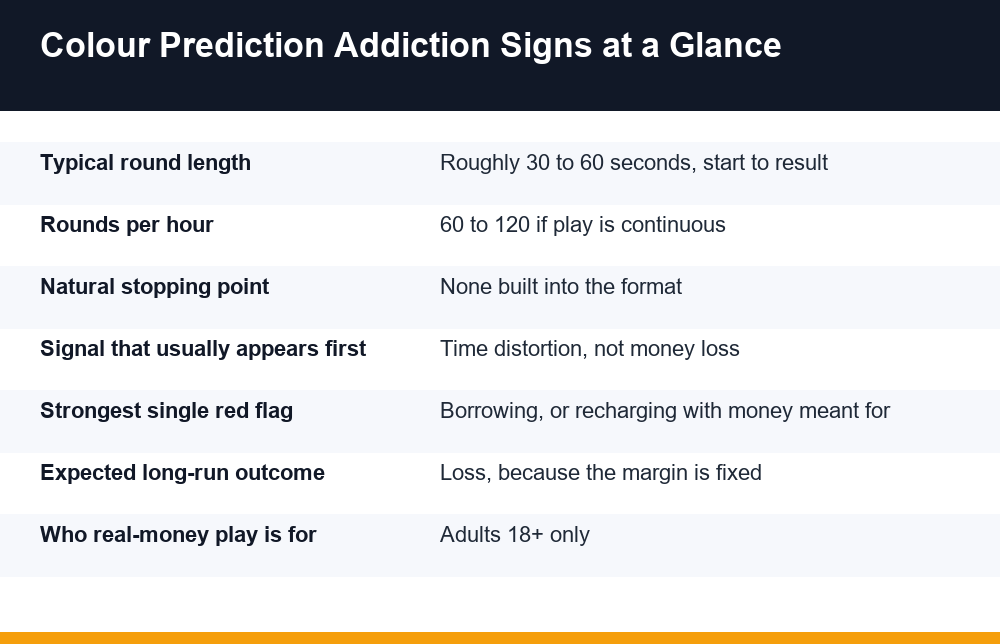
Start with the shape of the thing. A colour prediction round typically opens, closes and resolves inside 30 to 60 seconds. You choose, a countdown runs, a result appears, and the next round is already accepting entries. If play is continuous, that is somewhere between 60 and 120 complete outcomes per hour. Compare that with almost any other way of staking money on an uncertain outcome and the difference in rhythm is enormous — a single sports fixture might give you one resolution in three hours.
Three properties of that rhythm do most of the work. The first is feedback speed. Habit formation is sensitive to the gap between an action and its result: when the gap is measured in seconds, the two get linked tightly and the loop becomes self-reinforcing well before any conscious evaluation happens. A result that arrives next week teaches you very little in habit terms. A result that arrives in 30 seconds, over and over, teaches quickly.
The second is the absence of a natural stopping point. Many activities end on their own. A film finishes. A match ends. A shop closes. The round-based format has no equivalent boundary — no final whistle, no last hand, no closing bell. Every exit has to be a deliberate act of will against a screen that is already counting down to the next opportunity. Stopping is not the default state you drift into; it is a decision you have to make repeatedly, usually while tired, and it is the one decision the format never prompts you to make.
This structural point is worth sitting with, because it explains why people who genuinely intended to play for ten minutes report finishing at 2am. For a closer look at how session shape changes behaviour, it is worth comparing a rapid round-based session with a single cricket match session — the total amount staked can be similar while the number of individual decisions differs by a factor of a hundred.
The third is stake fragmentation. Each individual round asks for a small amount, and small amounts do not trigger the internal alarm that one larger amount would. Nobody deliberates over the cost of a single round. But the arithmetic of a hundred small rounds is not small, and because the decision is never presented as a total, the total is the last thing anyone notices. One of the most common colour prediction addiction signs is simply that a person can describe exactly how the last round went and has no idea what the evening cost in aggregate.
There is a fourth point that follows from the first three: the gap between rounds is where reflection would normally happen, and in this format that gap is a few seconds long and already filled with a countdown. In slower activities the pause between decisions is long enough for a second thought to form — you notice the time, you notice how you feel, you notice that you said you would stop. Compressing that pause does not remove the second thought so much as it removes the space the second thought needs. That is why interventions aimed at the inside of a session rarely work, and why the ones that work are set up before the session starts.
None of this requires anything unusual or hidden in a game’s design to be true. It follows from round length alone. That is the honest version of the mechanism, and it is more useful than vague warnings about willpower, because it tells you where to intervene: at the boundary of the session, not inside it.
8 Colour Prediction Addiction Signs Worth Taking Seriously
These are behavioural, not financial. People tend to watch for a dramatic loss and miss the eight things that reliably come first. Any one of them on its own may mean nothing much. Three or more appearing together over a few weeks is a pattern, and patterns are what matter here.
- Time distortion. You consistently and significantly underestimate how long a session lasted. Asked afterwards, your estimate is wrong by a wide margin — not occasionally, but as the normal case.
- Opening the app without deciding to. The sequence becomes unlock phone, open app, with no intervening thought. It has moved from an activity you choose into a default gesture, like checking notifications.
- Recharging with money allocated elsewhere. Rent money, grocery money, fee money, a friend’s repayment. The source of the next recharge starts to drift away from genuinely spare funds.
- Borrowing to continue. Any borrowing to fund play — from a person, a card, an app, a salary advance — is a significant signal regardless of the amount involved.
- Playing to get back to level. The session stops being about the next round and becomes about returning to a particular balance figure. The size of that target tends to grow after each bad run.
- Concealment. Deleting history, muting sound, switching screens when someone walks in, or giving a partner or parent a figure you know is not accurate.
- Mood that tracks the result curve. Irritability, flatness or restlessness in the hours after a session, and a noticeable pull towards play when bored, stressed or unable to sleep.
- Broken self-imposed limits. You set a cap on time or money, you meant it, and you went past it anyway — and this has now happened more than once.
Note what is not on this list: the total amount lost. Loss size is a consequence, not a signal, and waiting for it to become large enough to count is exactly how an early pattern becomes an entrenched one. Signals six and eight tend to be the most telling, because both involve the gap between stated intention and actual behaviour — and that gap is the thing that separates compulsive play from recreational play.
It is also worth being clear about what this list is and is not. It is a prompt to look honestly at your own behaviour, or to understand what a family member might be experiencing. It is not a diagnosis, and nothing on it can be scored into a verdict. If several items apply, the useful next step is a proper self-assessment and a conversation with a support service, not a self-administered label.
Money Signals: Recharges, Borrowing and Hidden Balances
The recharge step deserves separate attention because it is the only real friction point in the whole loop, and it is also where the clearest evidence lives. A single top-up at the start of an evening is a bounded decision. Four top-ups across one evening is a different behaviour, and the second, third and fourth are almost never planned. If you want one number to track, track the count of recharges per session rather than the amount — frequency reveals loss of control far earlier than totals do.
Borrowing is the signal that admits the least ambiguity. It does not matter whether the sum is small or whether you fully intend to repay it this week. Borrowing means current play is being funded by future income, and that is a structural change in the relationship with the game, not a cash-flow inconvenience. The same applies to money that technically exists but is earmarked — a deposit, a bill, somebody else’s share.
Hidden balances are the third money signal. This covers keeping a game wallet nobody else knows about, splitting funds across accounts so that no single statement shows the full picture, or routinely describing the week’s position in vague terms. Concealment of money is rarely about embarrassment alone; it usually exists because an accurate picture would force a conversation. For the mechanics of how small repeated top-ups erode a fixed amount faster than people expect, see the breakdown of the common traps that quietly drain a colour prediction bankroll.
There is also a scam layer worth naming purely as a warning, not as something to engage with. People in a losing stretch are routinely approached with offers of recovery money, guaranteed-result groups, paid prediction channels, people who claim they can reverse a loss, or recharge bonuses that require further deposits before anything can be withdrawn. Every one of these is aimed at the emotional state that follows a bad session. None of them changes the margin, because nothing changes the margin. If an offer arrives precisely when you are down, that timing is the point of the offer. Treat unsolicited contact after a loss as a red flag in itself — it means your situation is visible to someone who intends to profit from it.
A practical note on evidence. The money signals above are easier to see in a statement than in memory, and far easier to see in a statement covering a month than one covering a night. Pulling four weeks of payment history and marking every top-up takes about ten minutes and produces a picture that is very hard to argue with. People who do this are often surprised less by the total than by the distribution — the clustering of top-ups late at night, and the way they bunch after a bad run rather than before a good one.
Time Distortion and the Evening That Disappears
Time distortion is the most common early signal and the least often reported, because by definition you cannot notice it from inside. The mechanism is straightforward: in a format with no scene changes, no breaks and a uniform short cadence, there are no internal markers for the brain to count. A hundred near-identical rounds compress into something that feels like twenty minutes. The clock is the only reliable witness, and the clock is usually the thing people avoid looking at.
Practically, this shows up as sleep debt before it shows up as debt of any other kind. Sessions migrate later. Starting after midnight becomes normal, because that is when the house is quiet. Morning performance at work or in class slips, and the slip is attributed to general tiredness rather than to the specific 90 minutes that caused it. Among the colour prediction addiction signs that families notice first, a changed sleep pattern usually comes well ahead of any financial discovery.
There is a second-order effect too. Fatigue degrades exactly the faculty needed to stop — the ability to override an automatic impulse with a deliberate decision. So the late sessions are the ones where limits fail most often, which pushes sessions later still. Breaking that specific feedback loop is usually more effective than any amount of resolve applied at the wrong hour.
The displacement is worth measuring too, not just the duration. An evening absorbed by a round loop is an evening not spent on the things that normally regulate mood — sleep, exercise, company, a meal eaten at a table. Those are the same things that make the next session easier to resist, so their loss compounds. When people describe the point at which the pattern became obvious to them, it is frequently not a financial moment at all but a social one: a missed plan, a conversation they could not stay present for, a weekend that left no trace.
A simple way to make the distortion visible: before opening the app, note the time in a notes file. Note it again when you stop. Do not estimate — write both numbers. Most people find the first week of honest timestamps more persuasive than anything anyone else could tell them, precisely because it is their own handwriting rather than someone else’s warning.
Secrecy, Mood Shifts and the Stories People Tell Themselves
Concealment is a behavioural signal with almost no innocent explanation. People do not hide activities they feel neutral about. When someone starts closing the screen as a reflex, playing only when alone, or keeping play out of conversations where it would naturally come up, the hiding is itself the information — it means some part of them has already assessed the behaviour and does not want it examined.
Mood coupling is the companion signal. If the hours after a session are reliably worse than the hours before — flatter, shorter-tempered, harder to settle — the game has stopped being entertainment and started functioning as a regulator. The same applies in the other direction: reaching for the app specifically when stressed, bored, lonely or unable to sleep means it is doing a job that has nothing to do with the game itself.
Then there are the explanations people construct, which are worth recognising because they are remarkably consistent:
- “I only play small amounts.” True per round, and irrelevant across a hundred rounds. The unit of measurement is the session, not the round.
- “I’m up overall if you count last month.” Almost always based on remembered highlights rather than a complete record. Memory reliably over-weights wins.
- “I’ve worked out the pattern now.” There is no pattern to work out in a game of independent outcomes with a fixed margin, and the belief that there is tends to arrive at precisely the moment the stakes are rising.
- “One more round and I’ll stop.” The format offers an unlimited supply of one-more-rounds. A sentence that can be repeated indefinitely is not a plan.
- “I’ll stop as soon as I’m back level.” This makes stopping conditional on an outcome you do not control, which in practice means not stopping.
- “I can stop whenever I want.” Possibly true, and easy to test — the seven-day pause in the next section settles it one way or the other in a week.
The fifth one is the most dangerous. Deciding that a session ends only when a target balance is reached converts a bounded loss into an unbounded one, because the exit condition recedes every time it is not met. The mechanics of that specific spiral are set out in more detail in this breakdown of why chasing a loss reliably makes the position worse.
Self-Checks You Can Run This Week
The point of a self-check is to replace recollection with a record, because recollection is the part that fails. None of these require anybody else’s involvement, and all of them can be done inside a week.
Run the four checks below honestly. The table gives you the shape of a settled answer and the shape of a concerning one, so you are not left interpreting your own data without a reference point.
| Self-check | Settled answer | Warning answer |
|---|---|---|
| Write down your estimate of the last session’s length, then check the actual clock times | Estimate within roughly 20 percent of actual | Estimate less than half the actual duration |
| Count recharges per session for seven days | One planned top-up, or none | Two or more unplanned top-ups in a single session |
| Reconstruct the week’s total from records, not memory, and write your guess down first | Your figure is close to the record | The record is substantially worse than your figure |
| Try a full seven days without playing at all | Mild boredom, no particular pull | Restlessness, irritability, repeated urge to break the week |
The seven-day pause is the most informative of the four, and also the one people most want to skip or negotiate down to three days. That reluctance is data. If the idea of a week off produces immediate bargaining, note that reaction and take it seriously — it is one of the colour prediction addiction signs that no spreadsheet will show you.
If you are checking on someone else rather than yourself, the observable version is narrower but still useful: changes in sleep timing, phone-protective behaviour, vagueness about money that used to be straightforward, requests for small loans that do not fit their usual pattern, and a mood that seems to track something you cannot see. Lead with a question rather than an accusation. The concealment signal means a direct confrontation usually produces a better-rehearsed denial rather than a conversation, and the denial then has to be defended, which makes the next attempt harder.
Setting Time and Money Limits That Actually Hold
Most limits fail for a predictable reason: they are set in a calm moment and enforced in an agitated one, by the same person, with nothing in between. A limit that depends on your judgement at minute 90 of a losing session is not a limit — it is an intention. The limits that survive are the ones that remove the decision from the moment entirely.
- Decide the amount before the session, in a separate place. A figure written in a notes file at 7pm carries weight that a figure held in your head at midnight does not.
- Make the limit a single pre-session deposit with no second recharge. One top-up, and the session ends when it ends. The second recharge is where control is usually lost, so remove it as an option rather than resolving to resist it.
- Use a clock alarm, not a felt sense of time. Set it before you start, in another room if possible, and treat it as a hard stop rather than a prompt to reconsider.
- Never let an exit condition depend on an outcome. “I stop at 10:30” works. “I stop when I’m level” cannot work, because you do not control whether that ever arrives.
- Keep play and payment methods separated. Anything that makes a top-up take two minutes instead of ten seconds reinstates the friction the format strips out, and friction is the only thing that reliably interrupts an automatic loop.
- Use account-side blocking and cooling-off settings where they exist, and device-level app blocks where they do not. A barrier your midnight self cannot remove in a single tap is worth more than a stronger resolution.
- Tell one person the limit out loud. Concealment is a core part of the pattern, so a single informed person is both a check and a direct counter to the secrecy signal.
- Treat a broken limit as information, not as a moral failure. If a limit breaks twice, the limit was the wrong design — tighten the structure rather than renewing the promise.
A note on what limits can and cannot do. Limits control exposure. They do not improve expected outcomes, because the margin is fixed and no amount of discipline, timing or pattern-reading alters it. Over any meaningful number of rounds, loss is the expected result, and the only variable genuinely within your control is how much is exposed and for how long. Anyone framing limits as part of a strategy for winning has the relationship backwards.
There is one more design principle worth stating plainly: a limit should be boring to keep and awkward to break. If keeping it requires willpower every evening, it will fail eventually, because willpower is the resource the format depletes. If breaking it requires finding a password you deliberately made inconvenient, waiting out a cooling-off period, or admitting something to a person who knows the number, it is far more likely to hold on the night it matters.
If several of the colour prediction addiction signs described above are present at once — concealment, borrowing, repeated limit breaks — self-imposed limits are generally not sufficient on their own, and the next section matters more than this one.
Where to Get Help and What Support Looks Like
Asking for help early is uncomplicated and gets harder the longer it is deferred, which is the main argument for doing it at the signal stage rather than the crisis stage. Free, confidential support for gambling-related harm exists, and using it does not require having reached any particular threshold of loss.
A reasonable first step is a structured self-assessment, which takes a few minutes and produces something more objective than self-reflection. GamCare publishes a plain-language overview of the signs of gambling harm and what to do about them, alongside routes into free, confidential support. It is informational rather than diagnostic, and it is intended for adults.
Beyond self-assessment, support usually takes one of a few forms: a confidential helpline for an immediate conversation, free counselling delivered one-to-one or in groups, peer support with other people who have been through the same loop, and practical help with money management and account blocking. Many services also support family members separately, which matters because the people around someone in this pattern are often dealing with the financial consequences without any of the context.
It helps to know roughly what a first conversation involves, because the imagined version is usually worse than the real one. Nothing is reported anywhere, nobody is obliged to tell a family member, and there is no requirement to commit to stopping before being allowed to talk. The usual shape is a set of questions about frequency, amounts, time and impact, followed by options. Knowing that in advance removes one of the commoner reasons people put the call off.
Two further practical points. First, bring records rather than impressions to any first conversation — the timestamps and recharge counts from the self-check section make it considerably more productive. Second, if there is any thought of self-harm, that is an immediate situation rather than a gambling-support one, and a crisis line or local emergency service is the right call without delay.
The short version of everything above: the colour prediction addiction signs that matter arrive in behaviour before they arrive in a bank balance, the short round structure is what makes them easy to miss, and the fix is structural rather than motivational. Real-money play is for adults only, carries a genuine risk of harm, and over the long run produces losses by design.
Frequently Asked Questions
What are the warning signs of colour prediction addiction?
The earliest signals are behavioural rather than financial: badly underestimating how long sessions last, opening the app without a conscious decision, recharging with money meant for something else, borrowing to continue, playing to get back to a target balance, hiding play or understating it to family, mood that tracks the result curve, and repeatedly breaking limits you genuinely meant to keep. Any one may mean little; three or more together over a few weeks is a pattern worth acting on, and a good reason to run a structured self-assessment rather than to self-diagnose.
Why are fast prediction games so hard to stop playing?
Three structural reasons. The gap between action and result is roughly 30 to 60 seconds, short enough for a habit loop to form before conscious evaluation happens. The format has no natural ending — no final whistle or closing point — so every exit has to be a deliberate act against a screen already counting down. And each round asks for a small amount, so the aggregate cost is never presented as a single decision. None of this depends on anything hidden in the design; it follows from round length alone.
Is borrowing money to recharge a game a danger sign?
Yes, and it is the signal with the least ambiguity. The amount does not matter, and nor does an honest intention to repay quickly. Borrowing means current play is being funded by future income, which is a structural change in the relationship with the game rather than a temporary cash-flow issue. The same applies to using money that exists but is earmarked for rent, bills, fees or someone else’s share. Borrowing is also the point at which self-imposed limits usually stop being sufficient on their own.
How do short betting rounds affect self-control?
They remove the pauses in which self-control normally operates. Overriding an impulse takes a deliberate effort, and a 30-second cadence gives you 60 to 120 opportunities per hour to make that effort while fatigue steadily degrades your ability to make it. Because the rounds are near-identical, there are also no internal markers for the brain to count, so time compresses and the session runs far longer than it feels. Late sessions therefore fail limits most often, which pushes sessions later still.
How can I set time and money limits that hold?
Remove the decision from the moment rather than relying on judgement mid-session. Write the amount down before you start, make it a single pre-session deposit with no second recharge, set a clock alarm in another room as a hard stop, and never make your exit condition depend on reaching a particular balance. Keep payment methods separated so a top-up takes minutes rather than seconds, use account blocking or cooling-off settings where they exist, and tell one person the limit out loud. If a limit breaks twice, redesign the structure instead of renewing the promise.
Where can someone get help for gambling-related harm?
Free and confidential support for gambling-related harm exists and does not require having lost any particular amount. A structured self-assessment is a sensible first step, and GamCare publishes an overview of the signs of gambling harm along with routes into free support, including helplines, one-to-one and group counselling, peer support and practical help with money management and account blocking. Many services support family members separately. If there is any thought of self-harm, contact a crisis line or emergency service immediately rather than waiting.