
Expected value explained properly takes about ten minutes and removes most of the confusion around whether a betting system can work. It is not an advanced concept and it needs no mathematics beyond multiplication. It is simply the average result per attempt if you repeated something a very large number of times. Once the figure is negative, no staking pattern, no sequence of previous results and no amount of discipline makes it positive, because none of those things touch the terms of the bet. What follows is six examples in increasing complexity, each worked out in full, and then the part most explanations skip: what this number genuinely cannot tell you.
Table of Contents
Expected value explained in one sentence
Expected value is the sum of every possible outcome multiplied by its probability. That is the entire definition. If an outcome pays ₹100 and happens one time in ten, it contributes ₹10 to the average. Do that for every outcome, add them up, and the total is what one attempt is worth on average.
The word average is doing important work. The expected value of a single bet is frequently an amount you can never actually win, which strikes people as strange the first time they meet it. It describes the long-run average, not any individual result.
The only three inputs
Every calculation on this page needs the same three things: what you stake, what each outcome pays, and how likely each outcome is. If a product makes the third unknowable, the calculation cannot be done, and that unknowability is itself the most useful finding.
Example one: the fair coin
Stake ₹100 on heads. Heads pays ₹200 back, tails pays nothing. The coin is fair, so each side is 50 per cent.
Half the time you finish ₹100 up, half the time ₹100 down. Multiply and add: (0.5 × +100) + (0.5 × −100) = 0. The expected value is zero, which makes this a genuinely fair game.
Nobody runs a business on a zero. That is the point from which every real product departs, and the direction it departs in is always the same.
Example two: adding a margin
Now the same coin, but a win pays ₹190 rather than ₹200. Nothing about the coin has changed; only the payout has.
Half the time you gain ₹90, half the time you lose ₹100. (0.5 × +90) + (0.5 × −100) = −5. You now lose ₹5 per flip on average, or 5 per cent of every stake.
That five per cent is the whole business model, and it illustrates the central fact of the subject: the margin is not hidden in the odds of the event. It is in the gap between what the outcome is worth and what the product pays for it.
- Flip once: anything can happen
- Flip 100 times: you are likely down around ₹500
- Flip 10,000 times: you are down close to ₹50,000
- At no point does the per-flip figure improve
Example three: why roulette is honest about it
European roulette is a useful teaching case because the numbers are published and verifiable. Thirty-seven pockets: numbers 1 to 36, plus a single zero.
Bet ₹100 on one number. You win one time in 37, and the win pays 35 to 1, returning ₹3,600 on your ₹100. Expected value is (1/37 × +3500) + (36/37 × −100), which comes to about −₹2.70.
That is a house edge of roughly 2.7 per cent, and the reason it exists is visible: there are 37 pockets but the payout is calculated as though there were 36. The zero is the margin, sitting in plain sight on the wheel.
Every bet on the table has the same edge. Red, black, odd, even, a single number, a corner: all 2.7 per cent, because they are all paid as though the zero were not there. This disposes of the idea that some bets are smarter than others.
Example four: a short prediction round
Fast colour and number rounds work the same way, with one difference that matters enormously: the probabilities are not published, so you cannot verify them the way you can count roulette pockets.
Take the common structure where ten digits are split into colours and a colour covering five of the ten pays roughly double. Five in ten is a 50 per cent chance, and a payout slightly under 2x produces exactly the coin from example two. The arithmetic is identical; only the presentation differs.
Where a colour covers only two of the ten digits and pays considerably more, the headline figure looks generous. Work it through and the edge is usually similar or worse, because a bigger payout on a rarer outcome is how the same margin gets dressed up as an opportunity.
The important caveat is the one above. On a published wheel you can confirm the margin yourself. On an app that does not state its probabilities, you are relying on the operator’s description of a game only the operator can see, and that is a different kind of risk from a known 2.7 per cent.
Example five: stacking bets together
Combining selections multiplies the potential return, which is the appeal. It also multiplies the margin, which is not advertised.
If each individual selection carries a 5 per cent margin, a four-fold accumulator does not carry 5 per cent. The edge compounds across the legs, and the effective margin lands closer to 19 per cent. The big headline odds are large precisely because the probability of collecting has become small.
| Legs | Approximate total margin at 5% each |
|---|---|
| 1 | about 5% |
| 2 | about 10% |
| 4 | about 19% |
| 8 | about 34% |
This is why accumulators are promoted so heavily and single bets are not. They are the highest-margin product on the shelf, and they feel like the best value because the number at the end is the largest.
Example six: doubling up
The most persistent system there is. Lose ₹100, stake ₹200, then ₹400, and the first win recovers everything plus the original stake. It cannot fail, provided two things are true: unlimited money and no maximum stake.
Neither is true. Table and app limits exist specifically to stop this, and bankrolls are finite. Eight consecutive losses on an even-money bet is a roughly one in 256 event, which happens regularly, and the stake required at step nine is ₹25,600 to recover ₹100.
The deeper point is the one that settles the whole subject. Doubling changes the distribution of results, not the expected value. You win small amounts very often and lose a catastrophic amount rarely, and when you multiply those outcomes by their probabilities you arrive at exactly the same negative figure as flat staking. No sequence of stake sizes alters the terms of each individual bet, which is where the margin lives.
Why the long run arrives sooner than people think
People hear long run and picture years. On fast products it is measured in hours, and that is the part worth internalising.
A round every thirty seconds is 120 rounds an hour. At ₹100 a round with a 5 per cent edge, the expected cost is ₹600 an hour, every hour, regardless of how any individual round goes. Three evenings a week for a month is roughly 1,400 rounds, which is comfortably enough for the average to assert itself.
Slow products hide the edge because variance dominates for a long time. Fast products do not have that cover. The speed is exactly what converts a small theoretical margin into a reliable income for the operator, and it is the single most important variable in the whole calculation. Our explanation of how random number generators work covers the mechanism producing those results.
Where the edge is actually set
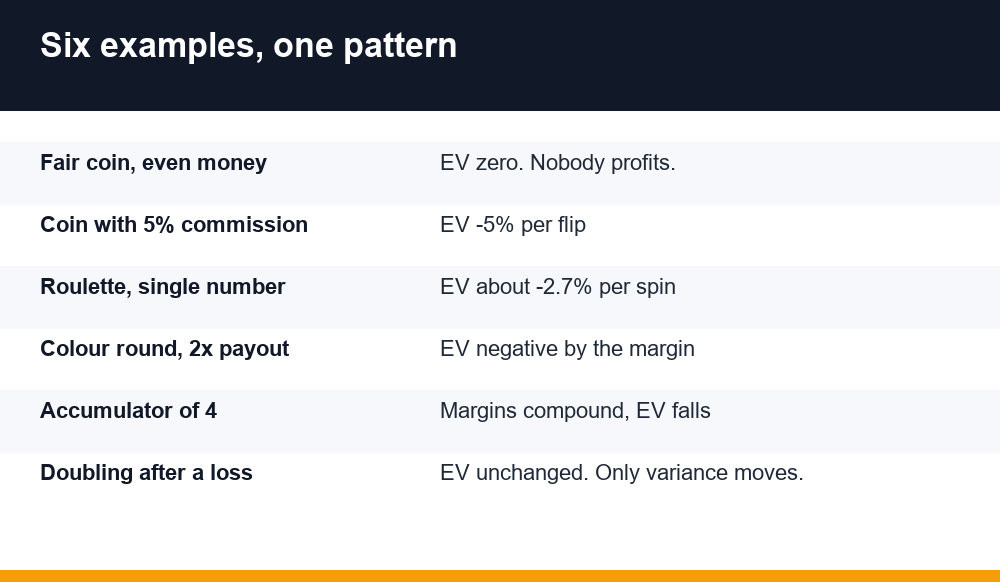
Running through six examples makes one structural point that is easy to miss when each is taken alone. In every case the margin came from the same place, and it was never the randomness.
The coin was fair in examples one and two. The wheel is fair in example three. What changed was the payout: ₹190 instead of ₹200, or 35 to 1 on a 36 to 1 chance. Expected value explained at this level is really a statement about the gap between true odds and offered odds, and nothing else.
That has a practical consequence. Arguments about whether results are genuinely random are usually beside the point, because a perfectly fair generator paying below true odds produces exactly the loss rate the operator intends. Rigging would be redundant, and on a regulated product it would also be a far larger risk than simply setting the payout table correctly.
It also tells you where to look. The payout table is published; the random number generator is not inspectable by you. One of those two is where the entire economics of the product lives, and it happens to be the one you can read before depositing anything.
- Find the payout for each outcome
- Work out the true probability of that outcome, if it is knowable
- Compare the two. The gap is the margin, per round
- If the probability is not knowable, that is the finding
What expected value cannot tell you
Honesty requires naming the limits, because expected value explained badly becomes its own kind of overconfidence.
It says nothing about any single session. A negative expectation game can and does pay out, and someone will finish tonight well ahead. The figure is an average over many repetitions, not a prediction of what happens next, and treating it as the latter is a misunderstanding in the opposite direction.
It also says nothing about variance, which is how widely results scatter around that average. Two games with identical expected value can feel completely different, one grinding slowly downward and the other swinging violently. Variance is what determines whether a bankroll survives long enough for the average to apply.
And it says nothing about value received. Someone who spends ₹500 on an evening’s entertainment and enjoys it has not been cheated by a negative expectation, any more than a cinema ticket is a bad investment. The calculation describes money, not whether the money was well spent. What it does settle, permanently, is the narrower question: no system, pattern or staking plan converts a negative figure into a positive one.
Frequently Asked Questions
What does negative expected value actually mean?
That on average, across many repetitions, each attempt costs you a predictable fraction of your stake. A 5 per cent negative expectation means losing about ₹5 per ₹100 staked over the long run. Individual results vary enormously; the average does not.
Can a betting system overcome a negative expected value?
No. Staking systems change how results are distributed, not the terms of each bet. Doubling after a loss produces many small wins and occasional very large losses, and when those are weighted by probability the expected value is unchanged from flat staking.
Why do accumulators have worse value than single bets?
Because the margin on each selection compounds. Four selections each carrying a 5 per cent margin produce a combined margin near 19 per cent. The potential return is larger, but the probability of collecting falls faster than the payout rises.
How many bets before the average takes over?
Sooner than most people expect on fast products. At two rounds a minute, a few evenings produce over a thousand attempts, which is generally enough for results to converge towards the expected figure. Slow products can hide an edge for far longer.
Does expected value mean I will definitely lose?
Not in any single session. It means the average outcome across many attempts is a loss of a predictable size. Plenty of people finish individual nights ahead, which is precisely why the arithmetic is worth understanding rather than relying on how a few sessions happened to go.