You probably arrived here because something about aviator predictor apps looked too clean to be fake: a phone screen, a small floating window showing 2.41x, and a round that stops almost exactly there a few seconds later. Maybe a channel admin sent it to you, maybe it was an autoplay clip, maybe someone you know swears it paid for a week. Before you download anything or send anyone an activation fee, it is worth knowing exactly how a crash round is produced, because the mechanism answers the question on its own. What follows is a teardown of the five claims these tools make, what is really happening in each case, and the second layer of scams that sits behind the first one.
Table of Contents
Why aviator predictor apps look convincing at first
The persuasive power of aviator predictor apps has almost nothing to do with mathematics and everything to do with video editing. A screen recording is not evidence of anything. It is a file that can be cut, re-timed, overlaid, or simply recorded in the opposite order: play the round first, note where it stopped, then film a second pass with a fake overlay that displays the number you already know. Nothing in a finished clip lets a viewer tell those two situations apart.
The asymmetry matters here. Producing a convincing fake costs one person an afternoon with a screen recorder and a basic overlay app. Producing a real demonstration would require something the round structure does not allow. When one side of a comparison is cheap and the other is impossible, the cheap explanation is almost always the right one, and no amount of polish in the clip changes that balance.
The second trick is selective display. A tool that spits out a number every round will land close to the real multiplier reasonably often by pure chance, because low multipliers are the most common outcome in crash formats. If the overlay says 1.4x and the round stops at 1.52x, the seller calls that a hit. The misses are never filmed. Over a hundred rounds you would see the pattern collapse, but promotional material is built from the handful of rounds where the guess happened to be near.
The third element is social pressure. These tools rarely arrive as a cold advert. They arrive inside a group where dozens of accounts are already posting congratulations, which makes scepticism feel like the odd position in the room. Recognising the staging is the first step; understanding the round mechanics is what makes the conclusion permanent.
Here is what almost every pitch contains, in roughly the same order:
- A short screen recording showing a prediction appearing before the round resolves
- A claim about reading the server, decoding the algorithm, or using artificial intelligence
- A free trial that produces a few convincing looking numbers
- A paid step: activation, a VIP key, a licence, or a one-time unlock
- A requirement to deposit on a specific platform, often with a referral link attached
- Screenshots of balances and a wall of short, enthusiastic comments
Every one of those elements is a persuasion device. None of them is a demonstration that a future multiplier was known in advance.
How the Aviator crash point is actually decided
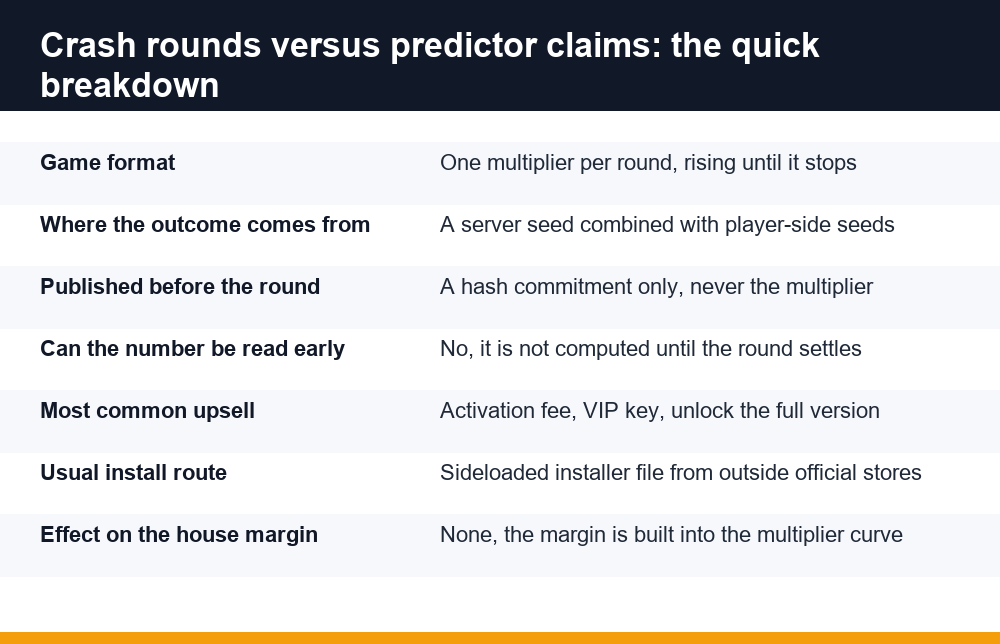
A crash round has one output: the multiplier at which the curve stops. In the provably fair model used by crash titles, that output is derived from a combination of inputs that are not all available in advance to anyone, including the operator. A typical construction works like this: the game server generates a secret value, often called the server seed, for a round or a chain of rounds. Before play begins it publishes a cryptographic hash of that value. A hash is a one-way fingerprint, so publishing it commits the server to a value it can no longer change without the fingerprint failing to match later.
Then player-side inputs are added. Many implementations also take seeds contributed by the clients participating in the round. The final multiplier is calculated by combining the server seed with those client seeds and running the result through a defined formula. Only when all inputs exist, at the moment the round locks and resolves, does a number come into being.
That is the sentence that settles the whole question. The crash point is not sitting in a database waiting to be read, and it is not travelling across the network ahead of time. It is the output of a calculation whose inputs are not complete until the round itself begins. There is nothing to intercept, because the thing being predicted does not yet exist. This is the same structural reason that recurring patterns never appear in other round-based formats either, a point covered in more depth in the breakdown of how colour prediction game algorithms actually produce each result.
It is worth dwelling on the interception claim made by aviator predictor apps specifically, because it is the one that sounds most technical and therefore most credible. Network traffic between a game client and its server can in principle be observed by whoever controls the device. What cannot be observed is a value that has not been generated. Even if a tool genuinely read every packet arriving on your phone, the earliest moment a crash multiplier appears in that stream is the moment the round resolves, which is also the moment you can see it on screen. Reading the wire gains nothing over watching the display.
It also explains why no amount of history helps. A tool that logs ten thousand past multipliers has a record of ten thousand completed calculations. Because each round draws on fresh inputs, the previous results carry no information about the next one. Pattern software applied to independent outcomes produces confident-looking output and zero predictive value.
What provably fair means in crash games, explained
Provably fair is a verification system, not a fairness promise and not a player advantage. The idea is narrow and specific: a player should be able to check after the fact that the outcome was not altered once bets were placed. That is all it does. It does not reduce the house margin, it does not make a game generous, and it certainly does not expose future results.
The verification sequence usually looks like this:
- Before the round, the server publishes a hash of its secret seed. You can record it.
- The round runs. Client seeds are combined with the server seed to produce the multiplier.
- Afterwards, the server reveals the plain server seed.
- You hash the revealed seed yourself and compare it with the value published in step one. A match indicates the seed was fixed before play.
- You re-run the published formula with the revealed seed and the client seeds and confirm it reproduces the multiplier you saw.
Notice the direction of travel. Every step that gives you certainty happens after the round. The pre-round publication is a commitment, a fingerprint of a secret, and a fingerprint cannot be reversed into the secret. If a hash could be unwound into its input, the entire scheme would be pointless and would be replaced immediately. Sellers of aviator predictor apps often borrow the phrase provably fair as if it were an admission that the data is lying around in the open. It means close to the opposite: the design exists precisely so that the number cannot be known early by either side.
There are also limits to what verification covers, and they are worth stating because sellers exploit the vagueness. Checking a seed tells you that one specific round matched its own commitment. It does not tell you how the formula distributes outcomes, whether the published formula is the one in use, or anything about the business behind the game. A verification page is a narrow technical receipt, not a seal of approval, and treating it as broad reassurance is exactly the confusion these pitches rely on.
One more thing worth stating plainly. Even a perfectly verified round is still a negative expectation bet. Verification tells you the dice were not swapped mid-roll. It says nothing about whether the dice favour you, and in a commercial crash game the curve is shaped so that they do not.
Do aviator predictor apps really work? The short answer
No. Not because every developer is incompetent, but because the task is impossible by construction. Asking whether aviator predictor apps work is like asking whether a thermometer can read tomorrow’s temperature off today’s air. The quantity has not been produced yet. Any software that displays a future multiplier is displaying a number it invented, a number copied from the last round, or a number recorded from a round that already finished.
It is useful to line up each claim against what is actually happening on screen:
| What the tool claims | What is actually happening |
|---|---|
| It connects to the game server and reads the next result | The app has no privileged channel to a remote server; the result is not transmitted in advance because it has not been computed |
| It decodes the algorithm using artificial intelligence | A model trained on past multipliers is fitting noise; independent rounds contain no signal to learn |
| It spots patterns in the last 100 rounds | Each round draws on fresh inputs, so prior outcomes are not evidence about the next one |
| It is free, you only pay to activate | The free stage exists to produce a convincing demo; the paid stage is the actual product being sold |
| Our users withdraw daily, see the screenshots | Balance figures and comment walls are the cheapest thing in the entire operation to fabricate |
The same reasoning dismantles progression schemes, rapid cash-out rules and supposedly safe low-multiplier routines that circulate alongside these tools. All of them rearrange when you stake rather than changing what any single round pays, which is exactly the failure mode described in the analysis of why so-called game systems collapse against a fixed margin. The margin is a property of the game, not of your timing.
A related confusion is worth clearing up. Some sellers retreat from the word prediction once challenged and start describing their tool as a probability assistant or a risk indicator instead. The softer wording does not change anything underneath. A distribution of likely outcomes is already visible in the game’s own published behaviour, costs nothing, and still tells you nothing about the round in front of you. Repackaging a known distribution as proprietary insight is a marketing move, not a technical one.
There is a simple check anyone can run without spending a rupee, and it has nothing to do with playing better. Open the tool, write down the next twenty predictions on paper before each round starts, then write down the twenty real multipliers beside them. Do not edit, do not skip rounds, do not count a prediction of 1.3x against a result of 4.7x as nearly right. Twenty rows of honest data is usually enough to end the conversation.
The activation fee loop and the deposit-again script
The prediction claim is the shopfront. With aviator predictor apps the money is made in the layer behind it, and that layer is designed as a sequence rather than a single sale. Understanding the sequence is more protective than understanding the mathematics, because the sequence is what actually drains people.
It typically runs in this order:
- Free demo. You install or open something and watch it produce numbers. No payment yet, which builds trust cheaply.
- Activation gate. The tool announces that full accuracy requires activation, a key, a licence or a VIP tier, for a modest sum.
- Deposit requirement. You are told the tool only syncs with a funded account, often on a platform chosen by the seller.
- Blame transfer. When losses arrive, you are told you cashed out late, used the wrong tier, or did not follow the signal correctly.
- Top-up loop. A larger balance, a higher tier or a second key is presented as the fix. This step can repeat indefinitely.
- Recovery offer. Sometimes a new contact appears promising to retrieve your earlier losses for a fee. This is a second scam aimed at the same person.
Every stage has a built-in excuse for the previous stage failing, which is the signature of a designed funnel rather than a product with a bug. Note also the payment pattern: these fees are usually requested through direct person-to-person transfers, informal wallet addresses or a stranger’s account number, rather than any checkable payment route. That request is itself the warning sign, regardless of what is being sold.
The small size of the first fee is deliberate. A figure low enough to feel like a rounding error gets past the part of your judgement that would scrutinise a large purchase, and once any money has moved the dynamic shifts. The next request is no longer a decision about whether the tool is real; it feels like a decision about whether to abandon what you already spent. Each step is sized to be the cheapest option available in the moment, which is how totals end up far above anything the person would have agreed to at the start.
The urgency language is part of the same machinery. Limited slots, a tier closing tonight, a key that expires in an hour: all of it exists to shorten the gap between the pitch and the payment, because the pitch does not survive a slow second look. A product that genuinely worked would have no reason to fear you thinking about it overnight.
A helpful mental reframe: if a tool genuinely produced reliable advance knowledge of a multiplier, selling access to strangers for a small fee would be an irrational business decision. The owner would simply use it. Any pitch that asks you to believe a money-printing machine is being distributed for pocket change is asking you to ignore the most obvious fact about it.
Installer files, permissions and device risk
Most aviator predictor apps do not arrive through an official app store. They arrive as a sideloaded installer file shared in a chat, hosted on a file locker, or pushed from a page full of redirects. That distribution route matters more than the software’s advertised purpose, because it removes the review layer that would normally stand between you and an unknown binary.
The practical concerns with a file like that are mundane and serious at the same time:
- Permission requests that have nothing to do with showing a number: SMS access, accessibility services, contacts, screen overlay, device administration
- Credential harvesting through a fake login screen that mimics a platform you already use
- Interception of one-time passcodes, which turns a nuisance app into an account-takeover tool
- Silent background installs or persistent components that survive a simple uninstall attempt
- Contact-list scraping used to spread the same offer to people who trust you
- Repackaged builds of the same shell under dozens of different names, so a clean reputation for one name means nothing
The accessibility permission deserves a line of its own, because it is the one people grant without thinking. Accessibility services exist so that assistive software can read what is on screen and act on a user’s behalf. Granted to something untrustworthy, that same capability can read fields as you type them and tap buttons without you. An app that only needed to display a number has no reason to ask for it, and the request alone is enough reason to stop the installation.
If you have already installed something like this, treat it as a device hygiene problem rather than a disappointment about a tool that did not work. Remove the app, review which permissions were granted and revoke anything unnecessary, change passwords for accounts you accessed from that device, and watch for authentication messages you did not trigger. Where money or account access has actually been lost, the official reporting channel in India is the government’s National Cyber Crime Reporting Portal, which handles online financial fraud and related categories.
Acting quickly matters more here than acting perfectly. The window in which a fraudulent transfer can be flagged is short, and the same applies to locking down an account whose one-time codes may have been read. If the same password was reused elsewhere, change it there too, starting with email, since an email account is usually the recovery route for everything else.
Fake testimonials, doctored balances and borrowed screenshots
Testimonials carry the weight that the technical claim cannot, which is why so much effort goes into them. The economics are stark: fabricating a wall of praise costs almost nothing, while building a tool that genuinely predicts the unpredictable is impossible. Sellers allocate effort accordingly.
Common tells, once you know to look:
- Balance screenshots that show a total but never a matching, dated transaction record
- Comments that praise an outcome without naming any specific round, stake or time
- Accounts with no history before the week they started posting, often with stock profile photos
- The same screenshot circulating under several different tool names and currencies
- Only wins are ever posted; a hundred-message thread with no losing session is a curated thread, not a community
- Visible edits: inconsistent fonts in a number, mismatched status bars, cropped timestamps
The group itself is usually part of the product. Comment walls can be staffed by a handful of accounts run by one person, or by paid posters working from a short script, which is why the enthusiasm so often arrives in the same phrasing. A useful habit is to ignore the volume of praise entirely and look instead for a single piece of checkable detail: a named round, a timestamp you can match, a sequence that includes a loss. That detail is almost never there, and its absence is more informative than a thousand positive messages.
This machinery is not unique to crash games. It is the standard playbook wherever someone sells certainty about a random outcome, and the identical patterns appear in paid signal groups and subscription services, as set out in the examination of how tipster and prediction sellers manufacture a winning record. The product being sold in every case is the feeling of an edge, not an edge.
One final structural point. A seller who publishes only wins has survivorship bias working for free. Even without any editing, selecting the best outcomes from a large pool of genuine results produces a track record that looks extraordinary and predicts nothing. When the selection is deliberate, the record is worthless as evidence no matter how real each individual screenshot might be.
Mistakes to avoid, and what to do if you already paid
The conclusions here are not about being cleverer than the tool. They are about recognising a category. Anything promising advance knowledge of a crash multiplier is making a claim that the round structure rules out, so the only remaining question is what the seller actually wants from you.
A short checklist:
- Treat any advance-prediction claim for a round-based game as settled: the number does not exist yet, so it cannot be read.
- Never pay an activation, unlock or VIP fee for software that claims to beat a random outcome.
- Do not sideload installer files sent through chat groups, however many people in the group vouch for them.
- Never share one-time passcodes, account credentials or screen access with anyone offering help or a tool.
- Discount screenshots entirely. Ask instead for a full, unedited sequence of predictions recorded before each round, including the losses.
- If a second contact offers to recover your earlier losses for a fee, treat that as a fresh attempt on the same wallet.
- Keep the twenty-round paper sheet described above if you want the point demonstrated rather than argued.
If you have already paid, stop at the current step rather than chasing the sunk cost. The top-up loop is specifically engineered to feel like one more payment away from working, and that feeling is the product. Secure the device, revoke the permissions, change the passwords, document what was sent and to whom, and report financial loss through the official channel rather than to a new intermediary who contacts you unprompted.
It is also worth saying that falling for one of these costs nothing in self-respect. The pitches are built by people who do this full time, tested on thousands of readers, and refined until they work. Recognising the structure after the fact is the useful outcome, and it transfers: the same funnel appears under new names, new interfaces and new games every few months, with only the branding changed.
A closing note on the broader point: this site’s position on aviator predictor apps is not that better ones exist somewhere. It is that the category is empty, and that the honest framing of any real-money round is simple. It is 18+, losses are the expected outcome over time, and no tool, signal or scheme changes that arithmetic. If the play has stopped feeling optional, free and confidential support services exist in most countries and are worth contacting before the next deposit rather than after it.
Frequently Asked Questions
Do Aviator predictor apps really work?
No. The multiplier for a round is calculated from inputs that are not all available until the round locks and resolves, so there is no existing value for software to read, intercept or decode beforehand. Anything displaying a future crash point is showing an invented number, a recycled previous result, or a figure recorded from a round that has already finished.
How does the Aviator crash point get decided?
A secret server seed is generated and a hash of it is published before play. Player-side client seeds are then combined with that server seed, and the combination is run through a defined formula to produce the multiplier. Because the inputs are only complete at the moment the round resolves, the outcome comes into existence then rather than sitting somewhere in advance.
What does provably fair mean in crash games?
It is an after-the-fact verification system. The operator commits to a secret seed by publishing its hash before the round, then reveals the seed afterwards so you can re-hash it, confirm it matches, and reproduce the multiplier yourself. It indicates nothing was altered once bets were placed. It does not lower the house margin and it never exposes a future result.
Why do predictor apps ask for activation fees?
Because the fee is the actual product. The free stage exists only to produce a convincing demonstration, and the activation, key or VIP charge converts that trust into money. The structure also creates a built-in excuse: when losses follow, the buyer is told they used the wrong tier or did not activate correctly, which sets up the next payment.
Are Aviator hack APK files safe to install?
Treat them as unsafe. They are distributed outside official app stores through chat groups and file lockers, which removes any review layer, and they commonly request permissions unrelated to showing a number, such as SMS access, accessibility services or screen overlay. That combination enables credential harvesting and interception of one-time passcodes.
Why do predictor sellers show fake testimonials?
Because fabricating praise is cheap while building a tool that predicts an unpredictable outcome is impossible, so effort goes where it works. Balance screenshots without matching transaction records, brand-new accounts, identical images reused under several tool names, and threads containing only wins are the usual tells.