The gamblers fallacy in betting is the belief that an outcome becomes more likely simply because it has not appeared for a while — that red is “due” after a run of black, that a quiet striker is “due” a goal, that a losing session has somehow earned a win. Academic write-ups usually stop at the coin-toss example. Casino blogs mention it in passing and then sell something. What follows is the version that actually connects to the bets people place: seven worked examples, the mirror-image error that looks like its opposite, the mental shortcut that keeps producing both, and a short checklist for spotting the thinking while it is happening rather than afterwards.
Table of Contents
Gamblers Fallacy in Betting Explained in One Minute
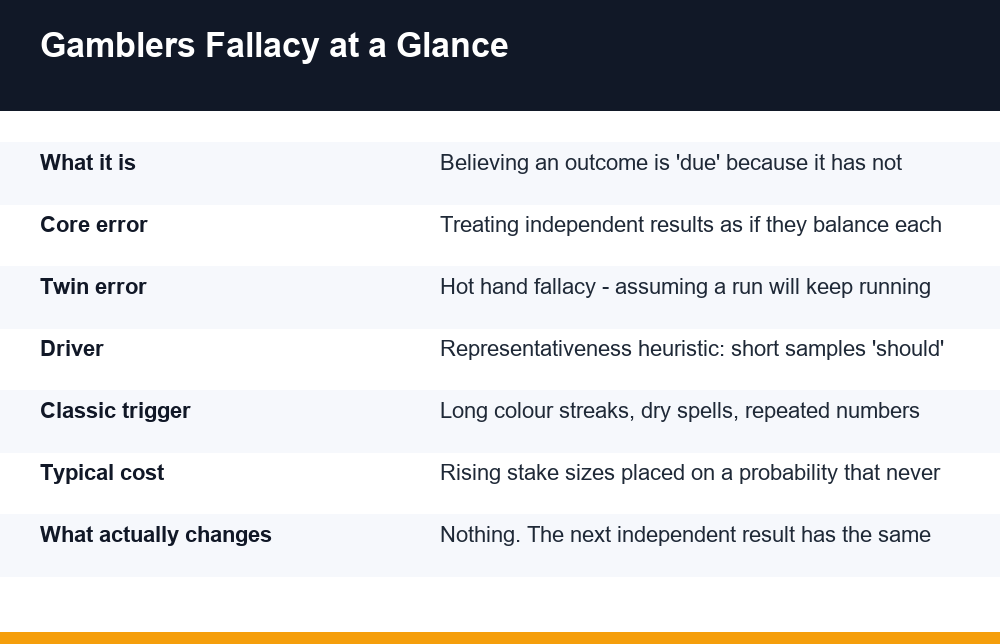
Here is the whole thing in one line: independent results have no memory, so nothing is ever owed. A roulette wheel does not know what it did last spin. A shuffled shoe does not track how many player wins it has handed out. A dice shooter’s next throw is not adjusted for the last six. When an outcome is independent, the probability of the next result is exactly what it was before the streak began — unchanged, indifferent, and completely uninterested in what anybody believes they are due.
The fallacy has a formal shape. It takes a long-run statement that is true — that over an enormous number of trials the proportions settle near their expected values — and smuggles it into a short-run prediction that is false: that the next few results will do the correcting. The long run has no deadline. It does not owe a correction tonight, this hour, or this shoe. It gets there by sheer volume of trials, not by nudging individual outcomes back into line.
It helps to see how the two statements come apart. Suppose a fair even-money market has produced eighteen losses in twenty rounds. Over a hundred thousand rounds the proportion really will sit close to half. But it does not get there by producing a compensating burst of wins; it gets there because eighteen out of twenty becomes a vanishingly small slice of a hundred thousand. The imbalance is not repaid. It is diluted. Those are completely different mechanisms, and almost all of the confusion lives in mistaking one for the other.
- The true part: across millions of spins, red and black land in close to equal proportion.
- The false leap: therefore, after eight blacks, red has become more likely.
- The reason it fails: the eight blacks are already in the record. They are not a debt. The next spin starts a fresh independent trial with its original odds.
- The quiet consequence: any staking decision built on the false leap is sized for a probability that does not exist.
Understanding the gamblers fallacy in betting does not make anybody a winner, and this breakdown will not pretend otherwise. The margin built into any real-money game is still there whether the reasoning is clear or muddled. What clear reasoning does change is the size of the hole: most of the damage this fallacy causes is not the wrong call, it is the escalating stake placed because of the wrong call.
Seven Worked Examples That Quietly Cost Money
Theory is easy to nod along to and easy to abandon at the table. These are the specific forms the gamblers fallacy in betting actually takes. Each one is recognisable, each one feels like insight in the moment, and each one rests on the same broken assumption.
1. The colour that is supposedly due
A board shows nine reds in a row. The pull toward black is almost physical — it feels as though the wheel has stretched a rubber band that must now snap back. It has not. On a single-zero wheel, black sits at 18 of 37 pockets before the streak, during the streak, and after it. Nine reds is an unusual-looking sequence, but unusual-looking sequences occur constantly; a wheel that never produced them would be the broken one.
2. The number that has not come up all night
Scoreboards that list recent numbers invite exactly this reading: find the cold number, back the cold number. But a single number’s chance is the same on every spin regardless of how long it has been absent. Absence is not pressure building up. A number can sit out hundreds of spins without anything accumulating, because nothing is accumulating. The scoreboard is a record, not a forecast, and it has no physical connection to the mechanism that produces the next result.
3. The team that is due a win
Sports results are not purely independent — form, injuries and fatigue are real. But “due” is not a mechanism. A side that has lost six is not thereby more likely to win the seventh; if anything the losses may be evidence about the side’s actual quality, which points the other way. The error here is reading a losing run as a stored credit rather than as information, and those two readings lead to opposite conclusions.
4. The striker who is due a goal
The same mistake at player level, and more seductive because a goal drought has a story attached. Markets price droughts in. A player going quiet for ten matches does not enter the eleventh with a raised floor, and anybody treating the drought itself as a reason has mistaken a pattern in the retelling for a change in the underlying likelihood.
5. Doubling the stake after each loss
This is the fallacy turned into arithmetic. The reasoning runs: a win must come eventually, so keep doubling and recover everything plus one unit. The flaw is not the doubling itself, which adds up exactly as advertised — it is the finite bankroll and the table ceiling sitting underneath it. Each round is still an independent trial at an unchanged probability, so the sequence is not converting losses into a win. It is concentrating a large loss into a short window and giving it the shape of a plan.
6. Reading a near miss as progress
Two matching symbols with the third just above the line reads as “almost”. On an independent draw there is no almost. A near miss is simply a loss arranged to look encouraging, and the fact that it feels like progress is a property of the display, not of the odds. Nothing about a stopped position tells anybody where the next one lands.
7. Switching after a win because the luck is spent
The fallacy also runs in the other direction: a win feels like a withdrawal from a fixed allowance, so the bettor moves on before it runs out. Nothing has been withdrawn. This is the same error as the “due” belief, just applied to good results, and it is a short step from here to the hot hand fallacy described further down.
Pattern-chasing is the common thread, and it scales. Entire categories of product — from the staking sequences sold around baccarat and cricket betting systems to fast-cycling colour games — are built on the assumption that a bettor will read a short sequence as a signal. The sequence is not a signal. It is just what randomness looks like close up.
Is Red Due After Ten Blacks? The Short Answer
No. And the cleanest way to see it is to write the number down and watch it refuse to move.
Take a single-zero wheel: 37 pockets, 18 red, 18 black, one green. The chance the next spin is red is 18 divided by 37, or about 48.6%. Now add streaks in front of it and recalculate.
| What has just happened | Chance next spin is red | Chance next spin is black |
|---|---|---|
| Nothing yet, first spin | 18/37 – about 48.6% | 18/37 – about 48.6% |
| Three blacks in a row | 18/37 – about 48.6% | 18/37 – about 48.6% |
| Seven blacks in a row | 18/37 – about 48.6% | 18/37 – about 48.6% |
| Ten blacks in a row | 18/37 – about 48.6% | 18/37 – about 48.6% |
| Fifteen blacks in a row | 18/37 – about 48.6% | 18/37 – about 48.6% |
The column does not change because the inputs do not change. What people are really sensing is a different and perfectly correct fact: before any spins happen, a run of ten blacks is unlikely. That is true. But once nine blacks have landed, the first nine are no longer uncertain — they are history, settled, probability one. The only thing still open is spin ten, and it is a lone trial at its original odds.
This is where the gamblers fallacy in betting does its most reliable work, because the question is usually asked backwards. “How likely is ten blacks in a row?” and “how likely is the next spin to be black, given nine already landed?” sound like the same question and are not. The first asks about a whole sequence that has not happened yet. The second asks about one spin, with nine of the ten slots already filled in. Only the first produces a small number, and only the second is the one anybody is actually betting on.
This is also why visible result histories are such effective decoration. Fast-cycling products lean on them heavily; the mechanics behind colour prediction games are a useful case study in how a scrolling list of past colours does nothing except invite a bettor to find structure that was never put there. The history display has no causal connection to the next draw. It exists because watching a pattern form holds attention, not because it carries information.
Why the Brain Sees Patterns in Random Results
This is not a failure of intelligence. Trained statisticians feel the pull too. It comes from a mental shortcut psychologists call the representativeness heuristic: when judging whether something came from a random process, people check whether it looks the way they expect random things to look.
The trouble is that our mental image of randomness is wrong. We expect it to be tidy — alternating, evenly spread, no long runs. Real randomness is lumpy. It clusters. Flip a fair coin two hundred times and runs of six or seven identical results are not anomalies; they are close to inevitable. When a sequence contains such a run, it fails the internal test for “looks random”, so the mind concludes something is off and a correction must be pending.
There is a simple demonstration of this that needs no equipment. Ask somebody to write down a made-up sequence of fifty coin tosses from imagination, then to flip a real coin fifty times and write that down too. The invented sequence is almost always too neat: it alternates more often than chance allows and its longest run is far shorter. People manufacture what they believe randomness looks like, and the belief is consistently tidier than the thing itself. The same mismatch is what makes a genuine streak feel like evidence that something has gone wrong.
- Small samples feel representative. We expect twenty spins to mirror the proportions of twenty thousand, when only the larger number has any reason to.
- Streaks are memorable. A run of eight stores vividly; the thousands of unremarkable alternations do not, so streaks feel rarer than they are.
- Narrative fills gaps. The mind supplies a cause – a wheel bias, a cold shoe, a changed dealer – because “no reason” is an unsatisfying explanation.
- Confirmation does the rest. The one time red arrives on cue is remembered as proof; the times it does not are filed as bad luck.
- Agency creeps in. Choosing the moment, the number or the amount makes an untouched probability feel steerable.
Support organisations treat these misreadings as a core part of gambling harm rather than a piece of trivia, and some of the clearest plain-language material on the subject comes from the sector’s own charities — GamCare publishes free and confidential information for anyone who wants the subject set out without a product attached.
Gamblers Fallacy and the Hot Hand Fallacy Compared
These two are usually taught separately, which hides the most interesting thing about them: they contradict each other, yet the same person will hold both within minutes, and both grow from the same root.
The gamblers fallacy says a streak will break — black has run eight times, so red is coming. The hot hand fallacy says a streak will continue — the run is going, so stay with it. One predicts reversal, the other predicts persistence, and a bettor will typically reach for whichever one matches the position already held.
| Gamblers fallacy | Hot hand fallacy | |
|---|---|---|
| Prediction | The run is about to reverse | The run will keep going |
| Typical phrasing | “Red is due”, “we’re owed a win” | “I’m on a roll”, “this table is running” |
| Usual trigger | A losing or one-sided streak | A winning streak |
| Shared root | Short sequences read as meaningful | Short sequences read as meaningful |
| Behavioural cost | Stake rises to catch the correction | Stake rises to ride the run |
| Where it can be partly true | Nowhere, for independent events | Only in skill tasks with genuine momentum |
One honest caveat: the hot hand is not always a fallacy. In skill-based activities — a basketball shooter, a batter settled at the crease — there are real mechanisms through which performance can cluster: confidence, rhythm, physical warmth, opponents adjusting. Researchers have gone back and forth on how large that effect is, and later work has argued the early dismissals understated it. None of that transfers to a wheel, a deck, a die or a random number generator, which have no skill component to get hot in the first place.
The asymmetry is worth noticing. Where the hot hand can be partly real, it is real because a person is doing something and getting better at it within a window. Where it is purely an error, the thing producing results is a mechanism with no state carried between trials. That single distinction — is there a performer, or only a mechanism — sorts almost every case correctly, and it is quicker to apply at the table than any amount of theory.
The practical point is that both errors push the stake in the same direction — upward — while the underlying probability holds completely still.
Independent Events, Dependent Events and Past Performance
Does the past affect the future? For independent events, no. But not everything is independent, and lumping the two together is how people end up either fooling themselves or throwing away real information.
An event is independent when the outcome of one trial does not alter the probabilities of the next. Spins of a wheel are independent. Dice throws are independent. Draws from a properly seeded random number generator are independent. For these, past results carry precisely zero predictive weight — not a little, not a hint, zero.
An event is dependent when earlier outcomes genuinely change what follows. Cards dealt from a shoe without replacement are the textbook case: every card removed alters the composition of what remains, so the probabilities for the next card really are different from the probabilities at the start. Sports sit in a different category again — not dependent in the shoe sense, but not memoryless either, because results carry information about underlying team quality.
- Independent: roulette spins, dice rolls, coin tosses, RNG draws, continuously reshuffled decks. Past results tell you nothing about the next one.
- Dependent: cards from a finite undealt shoe, draws from a pool without replacement. Earlier outcomes really do shift later probabilities.
- Informative but not mechanical: sports and competitive events. Past results are evidence about ability, never a stored debt that must be repaid.
The distinction matters because the gamblers fallacy in betting borrows credibility from the dependent category and applies it to the independent one. Somebody who has heard that card composition affects the maths of a dealt shoe may reasonably assume something comparable operates on a wheel. It does not. Nothing is being consumed or used up. The wheel has the same 37 pockets it had an hour ago, and it will have them tomorrow.
On the sports side the mistake inverts the evidence rather than inventing it. A long losing run is data. The question is what it is data about, and the most ordinary answer is that the side is weaker than assumed, the fixtures were harder than assumed, or both. Reading the same run as a credit balance requires believing results are drawn from a fixed quota rather than produced by teams, and nothing about competitive sport works that way. Worth adding that none of this points toward a profitable reading either; correcting the error removes a distortion, it does not supply an edge.
How the Fallacy Turns Into Real Losses
A mistaken belief about probability costs nothing by itself. It becomes expensive at the moment it changes the stake, and that is reliably what happens, because the belief arrives with a sense of certainty attached. If red is genuinely due, betting more on red is the consistent response. The conviction and the stake increase travel together.
Watch the arithmetic of a doubling sequence starting from one unit, and notice how fast conviction gets expensive:
- Loss 1 – stake 1. Total committed: 1 unit.
- Loss 2 – stake 2. Total committed: 3 units.
- Loss 3 – stake 4. Total committed: 7 units.
- Loss 4 – stake 8. Total committed: 15 units.
- Loss 5 – stake 16. Total committed: 31 units.
- Loss 6 – stake 32. Total committed: 63 units.
- Loss 7 – stake 64. Total committed: 127 units – and the next round, the one that is supposed to fix everything, now needs 128 units to recover a single unit of profit.
Seven consecutive losses on a near-even market is not rare. It turns up routinely across a long session. And at that point the bettor faces a stake 128 times the opening one, on an outcome whose probability has not budged since round one. The sequence did not reduce risk; it compressed a long, slow loss into a handful of rounds and dressed it up as recovery.
There is a second cost that is easier to miss. Escalation shortens the time available for second thoughts. A sequence that starts at one unit and reaches sixty-four can run through in a few minutes, which means the decision to stop has to be made while the numbers are moving and the conviction is at its strongest. The fallacy does not only misprice the next outcome — it removes the pause in which somebody might have noticed the mispricing.
This is where the gamblers fallacy in betting stops being a curiosity and becomes the engine of something harder to stop. The belief that a correction is owed is the same belief that makes walking away feel like locking in a loss that could still have been reversed, which is the psychology examined in more depth in this breakdown of why chasing losses escalates so quickly. The fallacy supplies the justification; the rising stake supplies the damage.
No reasoning removes the margin. Real-money play is 18+ and losses are the expected outcome over time — that is the design, not a run of bad luck. What an accurate picture of independence does is stop the loss from being multiplied by a false belief that it is about to be refunded.
A Checklist for Catching the Fallacy Mid-Session
Spotting the fallacy in the abstract is easy. Spotting it while it is happening, with a streak on the board and a stake already in hand, is the part that takes practice. These are the tells.
- The word “due” appears in the reasoning. Due is not a probability. If it is doing the work, there is no mechanism underneath.
- The stake rose after a loss rather than after new information. A streak is not new information about an independent event.
- A results history is being read. Ask what causal link could possibly connect that list to the next outcome. For independent draws there is none.
- A number feels overdue. Nothing accumulates during an absence. Absence is not pressure.
- The impulse is to switch away from something after a win. Same error, mirrored – good results are not a finite allowance being spent.
- The plan can only be stated as a story. “It has to come eventually” is a narrative. If it cannot be written as a probability, it is not one.
- The next round is framed as recovery. Recovery language is a reliable sign that the stake is being set by the size of the hole rather than by the odds.
The honest summary is unglamorous. Recognising this error does not create an edge, uncover a bias or produce a winning method — anybody selling that is selling the fallacy back with a price tag attached. It only removes one specific way of making things worse: the false certainty that turns a small, ordinary loss into a large, accelerated one.
Independent outcomes have no memory, no ledger and no sense of fairness. That is the entire lesson, and it is worth more than any pattern on any board.
Frequently Asked Questions
What is the gamblers fallacy in simple terms?
It is the belief that an outcome becomes more likely because it has not happened recently — that red is due after a run of black, or that a win is owed after losses. The error is treating independent results as if they balance each other out in the short term. They do not. Each spin, roll or random draw starts fresh at its original probability, no matter what came before it.
Is a colour due after a long streak of the opposite colour?
No. On a single-zero roulette wheel the chance of red is 18 in 37 — roughly 48.6% — on the first spin and on the spin after fifteen blacks. The streak is already settled history, not a debt the wheel has to repay. A long run of one colour looks wrong to us only because our mental picture of randomness is far tidier than real randomness ever is.
What is the difference between gamblers fallacy and hot hand fallacy?
They predict opposite things from the same mistake. The gamblers fallacy says a streak must break, so the other outcome is due. The hot hand fallacy says a streak will continue, so stay with what is running. Both read short sequences as meaningful, and both tend to push the stake upward. One caveat: in genuine skill activities, performance can cluster for real reasons, so the hot hand is not always an error there — but it is always an error on a wheel, a die or a random number generator.
Why does the brain see patterns in random results?
Because of the representativeness heuristic: we judge whether something is random by whether it looks the way we expect randomness to look. Our expectation is evenly spread and alternating, while real randomness is lumpy and full of streaks. A long run therefore fails our internal test and the mind concludes a correction is pending. Vivid streaks are also far more memorable than ordinary alternation, which makes them feel rarer than they are.
Does past performance affect independent events?
Not at all — for independent events such as roulette spins, dice rolls and random number generator draws, past results carry zero predictive weight. Some events are genuinely dependent, like cards dealt from a finite shoe, where each card removed really does change what remains. Sports results are a third case: they are informative about team quality but they are not a stored credit, so a losing run is more likely to be evidence of weakness than a sign a win is owed.