Most pages about the colour prediction game algorithm get one thing wrong before they write a single word of advice: they treat the result history as an input to the next round, when it is only an output of the last one. The rounds in these games are decided on a server you cannot see, by a process you cannot inspect, and the tidy chart of red and green dots on your screen is a record of what already happened — not a signal about what comes next. Everything else follows from that distinction.
This breakdown covers how a round is actually produced, why the chart looks structured when it is not, where the operator’s income comes from, and which claims about tricks, hacks and paid predictions fall apart the moment you ask what they would physically require. Real-money play is 18+ only, carries risk, and losses are the expected outcome over time.
Table of Contents
What Most Pages Get Wrong
Search for this topic and you will mostly find pages written to move you into an app. They share a recognisable shape: a few hundred words of vague mechanics, a promise that the colour prediction game algorithm can be “understood” or “decoded” with enough observation, then a list of “smart tips” that amount to watching the chart and betting against or with a streak. The mechanics section is deliberately thin, because a precise description would undercut the advice that follows it.
The error is not a small one. It is the difference between two completely separate kinds of system. In a system with memory — a shoe of cards dealt without replacement, a bag of tokens drawn and set aside — what has already come out genuinely changes what remains, and observation buys you real information. In a system without memory, each round is drawn from the same full set of possibilities as the one before it, and observation buys you nothing at all. Round-based colour games are built as the second kind.
Once you hold that distinction straight, the common claims sort themselves out quickly:
- “Red is due after a green streak.” This assumes the game is correcting an imbalance. Nothing in an independent draw tracks or corrects imbalance.
- “The pattern repeats every so many rounds.” A pattern found by looking backwards through a long history is a description of that history, not a rule about the future.
- “The algorithm reacts to big bets.” This is an assertion about internal server behaviour that no outside observer can confirm or deny — which is exactly why it is such a convenient thing to claim.
- “You can read the chart.” The chart is the only thing you are allowed to see, so every method built on it is built on the single surface the operator chose to publish.
It is worth noticing how much work the word “algorithm” is doing in that kind of writing. Used loosely, it suggests a machine with a visible logic — something that could in principle be reverse-engineered by a sufficiently attentive observer, the way a puzzle can be solved by studying it long enough. Used precisely, it just means a defined procedure, and a defined procedure can be completely specified and still tell you nothing whatsoever about its next output. A fair coin follows a perfectly well-defined procedure. Knowing the procedure in full does not help you call the next flip.
An honest account of these games has to be partly an account of what nobody outside the operator can know. That uncertainty is the real finding, and it is the part the promotional pages leave out.
How Does the Colour Prediction Game Algorithm Work?
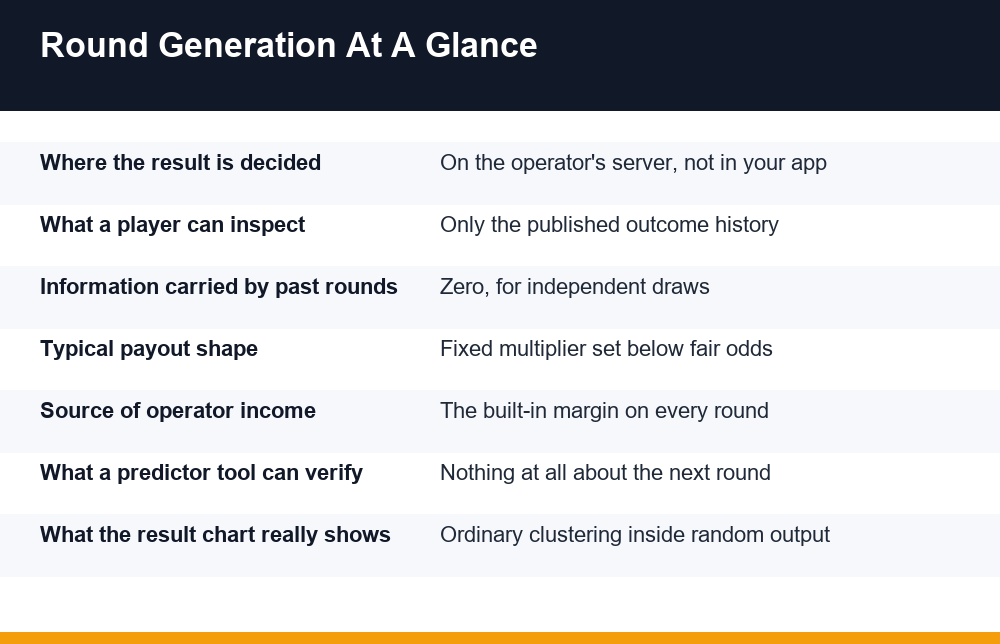
At the level that can actually be described, a colour prediction round is simple. A timer runs for a fixed interval. During that interval, players commit a stake to one of a small number of outcomes — typically two or three colours, sometimes a number band alongside them. When the timer expires, the server produces a result, publishes it, settles every stake against it, and opens the next timer. The visible loop is the countdown, the commitment window, the reveal and the settlement.
Expressed as a sequence, a single round of a colour prediction game algorithm looks roughly like this:
- The server opens a round with an identifier and a closing time.
- Clients display the countdown and accept stakes until the window closes.
- The server draws a value from a random source it controls — the player’s device plays no part in this step.
- That value is mapped onto an outcome, usually by splitting the range of possible values into segments, one per colour.
- The outcome is published, stakes are settled at the posted multipliers, and the result is appended to the public history.
Everything a player can observe sits in steps one, two and five. Steps three and four — the only steps that determine the result — happen entirely out of view. No amount of watching the countdown, logging results, switching devices or changing stake sizes gives you access to the draw itself, because the draw does not involve your device in any way.
Notice too that the mapping in step four is where the economics live. If one colour covers a smaller segment of the range, it is rarer, and it pays a higher multiplier. If a third colour overlaps the other two, it creates a rarer result with a bigger payout attached. These are design choices, not discoveries, and they are published openly because they have to be — they are the rules of the bet. What is never published is the draw.
The short round length deserves a mention of its own, because it is the design feature with the largest practical effect. A cycle measured in tens of seconds rather than minutes means a player can place a very large number of bets in a single sitting. Nothing about a fast cycle changes the odds on any individual round, but it compresses the timeline over which the margin accumulates. A rate of play that would take an evening at a table is reached in a few minutes here, and the expected cost scales with the number of rounds, not with the clock.
One further point about what the client application is actually doing. The countdown you watch, the animation at the reveal and the running history panel are all presentation. They are drawn from messages the server sends, and they can be made to look like anything at all without altering a single thing about how the result was chosen. Treating the interface as a window into the mechanism is the same mistake as reading a scoreboard as though it decided the match.
Random Number Generators, Seeds and Server-Side Results
The random source at the heart of any colour prediction game algorithm is almost always a pseudo-random number generator: a deterministic routine that starts from a seed value and produces a long stream of numbers that pass statistical tests for randomness. “Deterministic” sounds like an opening, and it is the hook that most hack claims hang on. In practice it is not an opening at all, for two reasons worth separating carefully.
First, generators used for this purpose are built so that the output stream reveals nothing useful about the internal state. You cannot watch a handful of results and reconstruct where the generator sits. Second, and more decisively, you never see the raw output. You see a colour — a result collapsed from a wide numeric range down to one of two or three buckets. Almost all the information in the draw is discarded before it reaches you. Reconstructing a generator’s state from heavily compressed output you cannot even timestamp precisely is not a hard version of the same task; it is a different task altogether.
It is worth being concrete about the scale of that loss. A generator might be working with a range of billions of possible values. Mapping that range onto two colours throws away essentially all of it, leaving you with a single bit per round. Even a long observation period gives you a very short string of bits, with no reliable information about which generator is in use, when it was seeded, how many values were drawn between the rounds you saw, or whether the same generator instance was serving your round at all. Every one of those unknowns has to be resolved before the determinism of the routine becomes useful to anyone, and none of them is observable from a client.
Some operators layer a commitment scheme on top, publishing a hash before the round and the seed afterwards so the result can be checked against the pre-commitment. Where that genuinely exists and is genuinely verifiable, it proves one narrow thing: the result was fixed before stakes closed. It does not prove the seed was chosen fairly, that the outcome segments match what is advertised, or that the history you are shown is complete. And on a large share of apps in this category no such scheme exists at all — the result simply arrives, with no accompanying evidence of anything.
There is also a gap between a scheme existing and a scheme being used. Checking a pre-commitment properly means recording the published hash before the round closes, recording the revealed seed afterwards, and recomputing the hash yourself to confirm the two match. Almost nobody does this, and an interface that displays a hash string is not the same as an interface that has been checked. A visible hash satisfies the appearance of verifiability at close to zero cost, which is a reason to treat its presence as a prompt to verify rather than as a conclusion already reached.
This is the honest position. The generation process is unobservable from the outside, and on most of these apps it is also unaudited by any independent party. That is not a claim that every result is manipulated. It is a statement that you have no mechanism to tell the difference, which is a serious problem in its own right and a very different conclusion from “it is random, so it is fair”.
Why Past Rounds Carry Zero Information
If each round is an independent draw from the same fixed set of probabilities, then the probability of the next result is identical whether the last ten rounds were all red, all green, or perfectly alternating. This is not a subtle statistical point open to interpretation. It is the definition of independence, and it is the design intention of every round-based game of this type.
The intuition that fights it is the belief that randomness must balance out over short runs. It does balance out, but only in the sense that proportions drift toward their expected values across very large numbers of trials — and it does so without any corrective force acting on individual rounds. A long run of one colour does not create pressure for the other. The sequence has no memory to store the imbalance in, and no mechanism by which it could ever repay it.
A useful way to test the intuition is to notice that it cannot be made precise. If one colour is “due” after a run, how long must the run be, by how much are the odds shifted, and where is that shift stored between rounds? Every attempt to answer produces either a number nobody can justify or a mechanism nobody can point to. Beliefs that dissolve the moment you ask them to be specific are usually not findings about the system but descriptions of how the system feels to watch.
This is why every staking method built on sequence-reading collapses at the same point. Doubling after losses, waiting for a streak of a certain length, alternating on a schedule, betting the colour that is “behind” — each one is a rule for choosing when and how much to stake, and none of them changes the probability of the outcome being staked on. The same structural failure shows up across the whole family of approaches, which is why the underlying reason betting systems fail is exactly the same here as it is at a roulette table or on a sports market.
There is one more consequence worth stating plainly. Because past rounds carry no information, nobody can be better at predicting the next colour than anybody else. There is no skill ceiling to approach and no expertise to acquire or buy. Anyone selling access to superior prediction is selling something that cannot exist in a system with these properties.
Why Colour Prediction Charts Look Like Patterns
The result history is the most persuasive thing on the screen, and it is persuasive for reasons that have nothing to do with the game. Genuinely random sequences are much lumpier than people expect. Ask someone to write down a random-looking sequence of fifty coin flips and they produce something far too evenly alternated, with far shorter runs than chance actually delivers. Real randomness produces streaks of five, six or seven in a row at rates that feel impossible but are entirely ordinary.
So the chart is full of structure, and the structure is real in the sense that it is genuinely there on the screen. What it is not is predictive. Four things amplify the illusion:
- Clustering is normal, not notable. Runs and near-alternations appear in any independent sequence. Seeing them tells you nothing except that the sequence is behaving as expected.
- The search space is enormous. If you are free to look for any pattern, over any window length, with any rule for what counts as a match, you will always find something. A pattern discovered after the fact, with no constraint on how you searched, carries no predictive weight.
- Confirmation is one-sided. A method that “works” is remembered as evidence. A method that fails is remembered as a misread of the chart, not as a refutation of the method. Under that accounting, no method can ever be wrong.
- The display is designed to be read. Colour-coded dots, run counters and percentage splits all signal that there is something here worth analysing. A plain text log of the same results would feel far less meaningful, and would be exactly as informative.
There is a simple way to feel the force of the second point. Flip a coin a few hundred times, write the results in a row, and then go looking for rules. You will find stretches where every third entry matches, windows where one side dominates heavily, and sequences that look like a repeating motif. All of it is in the data, none of it was put there, and none of it continues. A result history has exactly the same character, with the difference that the display is built to make the structure easy to see.
Pattern-hunting in noise is not a character flaw; it is the same faculty that makes people good at spotting a familiar face in a crowd. It simply has no traction on a sequence with no memory, and the interface gives it a great deal of surface to work on.
The Margin: Where the Money Actually Goes
The reason a colour prediction game algorithm does not need to be manipulated to be profitable for the operator is that the payout table already does the work. The multiplier attached to each outcome is set slightly below the level that would make the bet break even over time. That gap is the margin. It applies to every stake, on every round, regardless of which colour you pick, how you size your stakes, or how long you have been studying the chart.
The structure is easiest to see when the familiar claims are set beside what each one would actually require:
| Claim you will encounter | What it would require to be true | What an outside observer can actually check |
|---|---|---|
| Past results indicate the next colour | Rounds that are not independent draws | Nothing — independence cannot be confirmed or refuted from published history alone |
| A tool predicts the next round | Access to the server’s random state | Nothing — the tool’s claim is unfalsifiable by design |
| A staking plan overcomes the margin | A payout above fair odds on some outcome | The posted multipliers, which are set below fair odds |
| Bigger stakes change the outcome | Result selection conditioned on stake size | Nothing from outside; the claim is untestable by players |
| One verified round proves fairness | Audited seeds, segments and complete history | Only that a single result matched a prior commitment, where such a scheme exists at all |
The right-hand column is the uncomfortable one. For most of these claims the honest answer is that a player cannot check. That cuts both ways: accusations of manipulation are usually unprovable, and assurances of fairness are equally unprovable. What is checkable is the payout table, and the payout table alone is enough to make sustained profit the expected outcome for the operator and sustained loss the expected outcome for the player.
The margin also explains why so much of the surrounding marketing concentrates on volume rather than on outcomes. Faster rounds, one-tap repeat staking, saved bet sizes and in-app prompts to continue all increase the number of rounds played in a session. None of them has to alter a result to be worth building, because the expected loss is proportional to total turnover. An operator optimising for turnover and an operator optimising for player losses are, under a fixed margin, doing exactly the same thing.
This is also the cleanest line between these games and markets where analysis genuinely matters. In a priced market, a participant can in principle disagree with the price and be right. In a fixed-multiplier draw with no information available about the draw, there is nothing to disagree with. That structural contrast is worth understanding properly, and the difference between fixed-multiplier colour rounds and value-based betting markets is the sharpest illustration of it.
Rigged Versus Unaudited: Two Different Questions
“Is the colour prediction game algorithm rigged?” is the question people actually want answered, and it hides two separate questions that deserve separate answers. The first is whether results are being altered round by round to target individual players. The second is whether anyone independent has verified that the game does what it says it does. These are not the same question, and conflating them produces bad reasoning in both directions.
On the first: nobody outside the operator can answer it, and a losing run is not evidence either way. Losing runs are the expected product of a negative-margin bet repeated often, so they appear just as readily in a game that generates results honestly as in one that does not. Players who lose steadily and conclude the game must be rigged have reached a conclusion their evidence cannot support — even though it is also a conclusion they have no way to rule out.
The reverse error is just as common and gets much less attention. Seeing a plausible-looking spread of colours in the history, or a run of wins early in a session, is not evidence of honest generation either. A result history can be entirely consistent with fair independent draws and still have been produced by something else, because the published history is itself supplied by the party being assessed. Evidence that the party under question controls is not independent evidence, whichever direction it happens to point.
On the second question, the answer for a large share of apps in this category is straightforward: no independent verification exists, none is published, and no mechanism is offered by which a player could obtain any. That is the finding that matters, because it means the fairness of the draw rests entirely on the operator’s own say-so. An operator with a margin on every round does not need to manipulate anything in order to profit — but “does not need to” is a statement about incentives, not a guarantee about conduct, and you are being asked to accept it on trust.
The practical upshot is to stop asking whether the game is rigged and start asking what you can verify. Usually the answer is the multiplier, the round timer, and nothing else. If the amount of money involved has reached the point where this question feels urgent rather than academic, that urgency is itself worth attending to — the free self-assessment and support resources published by the charity GamCare are a far more useful reference at that stage than any further analysis of the chart.
Prediction Sellers, Hack Apps and the Mechanics Behind Them
Around every game of this type grows an economy of people selling the one thing the game cannot provide. The products vary — subscription channels posting calls, downloadable “predictor” software, paid signal groups, mentorship offers, screenshots of winning balances — but the mechanics underneath are a short list, and recognising the list is more useful than evaluating any individual claim.
These are the patterns that recur, described so you can identify them rather than so you can choose between them:
- Split-call broadcasting. Different subsets of an audience receive opposite calls. Every round, some portion of the audience sees a correct prediction, and those screenshots become the marketing material. Nobody ever sees the full distribution of calls that were sent out.
- Selective record-keeping. Results are posted after the fact, with losses quietly omitted or reframed as entries that were “not confirmed”. A record you cannot audit from the outside is not a record.
- Software theatre. A predictor app displays an animated analysis and outputs a colour. Since it has no connection to the server’s random source, the output is generated locally and is indistinguishable from a guess. The same template circulates across multiple games — the parallels with the way predictor apps are marketed around crash-style games are close to exact.
- Deposit-linked escalation. Free calls are followed by advice to increase stakes to “recover” a losing sequence, which raises turnover and therefore the margin extracted, whoever ends up collecting it.
- Access and recruitment fees. Earnings come from subscriptions, group entry or referrals rather than from the game itself, which is why the offer survives regardless of whether the calls are right.
A related risk is worth flagging because it has nothing to do with whether a prediction is right. Downloadable predictor files are typically distributed outside ordinary app channels, and installing software from an unverified source to interact with an account that holds money is a poor combination regardless of what the software claims to do. The same applies to tools that ask for account login details in order to “sync” with a game. A request for credentials is a cost that is paid whether or not the promised capability exists, and the promised capability does not exist.
There is a logical shortcut that handles all of these at once. If a method reliably predicted the outcome of a fixed-multiplier draw, its value would come from using it rather than selling it, and selling it to a growing audience would be strictly worse than keeping it private. A product that only makes commercial sense if the method does not work is telling you something about the method. This is set out here as a warning about how such offers are constructed, not as a comparison of which to pick — none of them should be picked.
Questions Worth Asking Before You Believe a Claim
The most durable defence against claims about any colour prediction game algorithm is not a counter-theory but a short set of questions. Each one is answerable without statistical training, and each one is fatal to the great majority of what circulates on this subject.
- What would this person need access to? If the claim requires knowledge of the server’s random state, and they do not have it, the claim is finished right there.
- Could this claim ever be shown to be wrong? A method that explains every loss as a misapplication of itself is not making a prediction at all.
- Was the pattern found before or after the data? A rule stated in advance and then tested is evidence. A rule extracted from a history you already hold is a description of that history.
- Who profits if I act on this? Follow the subscription, the referral link and the deposit. The answer is rarely ambiguous.
- What can I verify myself? Usually the multiplier and the timer. If everything else rests on assertion, treat it as assertion.
- Does the payout exceed fair odds on any outcome? If not, no selection rule and no staking plan changes the expected result, because none of them touches the margin.
- Why does this question matter to me right now? If the motivation is recovering money already lost, the question has stopped being about mechanics.
The questions work because they test the structure of a claim rather than its content, which means you do not have to out-argue anybody on the detail. A claim that fails question one fails whatever evidence is attached to it, and a claim that fails question two was never a claim about the future in the first place. Most of what circulates on this subject fails one of those two before you reach the third.
Run those seven questions over any colour prediction content you encounter and very little survives. What remains is a plain description: a short timer, a hidden draw, a published multiplier set below fair odds, and a result history that reads like information but is not. That description is less exciting than the pages promising decoded patterns, and it carries the single advantage of being accurate. Real-money play is for adults only, the margin applies to every round, and losses are the expected outcome over any sustained period of play.
Frequently Asked Questions
How does the colour prediction game algorithm work?
A round opens with a countdown, players commit stakes to one of a few colours, and when the timer expires the server draws a value from a random source it controls and maps that value onto an outcome. The result is published and stakes are settled at the posted multipliers. Your device plays no part in the draw, so the only parts you can observe are the timer, the betting window and the published result.
Can you predict the next colour in a prediction game?
No. The rounds are designed as independent draws, which means the probability of each outcome is identical regardless of what came before. There is no information in the result history to extract and no access to the server’s random state, so nobody can be better at predicting the next colour than anybody else. That also means there is no expertise on this subject that anyone could legitimately sell you.
Are colour prediction games rigged?
That hides two questions. Whether results are altered round by round is something no outside observer can establish, and a losing run is not evidence either way, because losing runs are the expected product of a negative-margin bet. Whether anyone independent has verified the draw is a different question, and on a large share of these apps the answer is that no verification exists and none is offered to players.
Do colour prediction games use a random number generator?
Typically yes — a pseudo-random generator running on the operator’s server, seeded and then mapped onto the colour outcomes. Deterministic sounds exploitable, but you never see the generator’s raw output, only a result compressed down to one of two or three colours. Almost all the information in the draw is discarded before it reaches you, which makes reconstructing the generator’s state from the visible history unworkable.
Why do colour prediction charts look like patterns?
Because genuinely random sequences are far lumpier than people expect, producing long runs and near-alternations at ordinary rates. Add an unlimited freedom to search any window length for any rule, plus the habit of remembering hits and excusing misses, and patterns become inevitable. The colour-coded display reinforces it by signalling that the history is something to be analysed, when it is only a record of settled rounds.
Is there any trick to win colour prediction games?
No. Every selection rule and staking plan changes when and how much you stake, not the probability of the outcome you stake on, and the posted multipliers are set below fair odds on every option. That margin applies to each round regardless of approach, so losses are the expected outcome over time. Anything marketed as a trick, hack or predictor is a product that only makes commercial sense if it does not work.