Almost every page with casino rng explained in the title makes the same mistake: it treats the random number generator as the answer to the question “is this fair?” and stops there. The RNG is presented as a seal of trust, a piece of mathematics so clean that nothing else needs discussing. That framing is convenient, because it moves attention away from the part of the system that actually determines what happens to your money. A random number generator decides which outcome lands on a given round. It says nothing whatsoever about what that outcome is worth.
Those payout values – and therefore the house edge – are set deliberately by the people who built and configured the game, and they are set so that the expected result of extended play is a loss. A perfectly random game can take money from players relentlessly, and most do. This breakdown separates the two ideas, explains what independent testing houses genuinely verify, and is honest about where that verification simply does not reach. Real-money play is for adults only, carries risk, and losing is the expected outcome rather than the unlucky one.
Table of Contents
What Most RNG Pages Get Wrong
The standard article on this topic performs a sleight of hand. It explains that results are generated by an algorithm nobody can predict, concludes that the game is therefore “fair”, and leaves the reader with the impression that fairness and profitability for the player are the same thing. They are not related at all. A coin toss is perfectly random; a coin toss that pays you 1.8 times your stake for a correct call is a reliable way to lose money. Randomness describes the unpredictability of the draw. The pay table describes the economics. Only the second one has a direction, and the direction points away from the player. The point of casino rng explained properly is that each call is independent.
This matters because the confusion is useful to people selling things. If randomness is treated as the whole story, then any complaint about losing becomes a complaint about luck, and any product promising to beat the game can position itself as a way to outwit the algorithm. Prediction sellers, pattern trackers and “RNG crack” sellers all depend on readers believing the generator is the thing to attack. It is not. The generator is the least negotiable part of the machine. The negotiable part – the configured return – was decided before you arrived and is not something strategy touches.
The second habit worth naming is uncritical citation of certification logos. Pages list testing-house names as though the presence of a logo on a website were proof that the specific build you are playing was examined. That inference does not hold, and the gap between “this game was once tested” and “this copy of this game, on this app, behaves as tested” is where most real problems live. We will come back to that gap in detail, because it is the single most practically useful thing to understand here.
There is also a vocabulary problem. Marketing copy uses “certified”, “audited”, “tested” and “provably fair” as though they were interchangeable synonyms for trustworthy, when each describes a narrow and quite different claim. A statistical test of output streams, an inspection of a maths model, a checksum of a submitted build and a cryptographic commitment scheme are four separate things. Collapsing them into one word is how a reader ends up believing far more has been established than actually has.
Finally, these pages almost never mention that the house edge varies enormously between games and between configurations of the same game. A reader who absorbs only “it’s random” has no way to distinguish a product with a modest built-in margin from one with a punishing one. That distinction is covered properly in our breakdown of how the house edge compares with the idea of finding value, and it is a far more useful thing to know than the internal workings of any algorithm.
How Does an RNG Work in Casino Games?
Casino RNG Explained: The Seed, the Sequence and the Mapping
At a technical level the mechanism is less mysterious than the marketing implies. Almost all commercial casino software uses a pseudorandom number generator: a deterministic algorithm that takes a starting value, called a seed, and produces a very long sequence of numbers that passes statistical tests for randomness. The sequence is not random in a philosophical sense – the same seed always produces the same sequence – but it is unpredictable to anyone who does not know the seed and the internal state, and that is the property the game needs.
The generator runs continuously, producing numbers thousands of times per second whether or not anyone is playing. When you press the button, the software takes whatever number is current, maps it onto the game’s outcome table, and displays the result. On a slot, that mapping assigns ranges of numbers to each symbol position on each reel. On a virtual roulette wheel, it maps to one of the 37 or 38 pockets. On a card game, it determines a shuffle order. The animation that follows – spinning reels, a ball rolling, cards flipping – is theatre rendered after the fact. The outcome was fixed the instant you committed.
Three details are worth holding onto. First, the mapping step is where game design happens. Symbols are not distributed evenly across reel positions; high-paying symbols occupy far fewer slots in the number range than low-paying ones, and modern games often use different reel strips for different reels. The generator treats every number as equally likely, and the designer decides how many numbers correspond to each result. That is how a game can be statistically clean and still pay out exactly what its maker intended.
Second, where the generator physically runs matters more than how it is built. In established products the outcome is produced on the supplier’s own servers and the result is sent to your device, which means the app in front of you is a display layer rather than the thing deciding anything. In products built without that separation, the outcome logic may sit much closer to the operator, and there is no external way for a player to tell which arrangement is in use. Seeding practice is a related point: a well-built system draws its initial entropy from unpredictable physical sources rather than from something guessable like a clock reading, and this is one of the specific things an independent review is designed to examine.
Third, so-called provably fair systems work differently and deserve a mention. These publish a cryptographic commitment to a server seed before the round, combine it with a seed the player can influence, and let the player verify afterwards that the published result matches the commitment. That construction genuinely does let you check that a specific result was not altered after you bet. It still does nothing about the pay table. A provably fair product with a wide margin is a product you can prove is taking a predictable cut.
RNG vs RTP: Two Completely Different Questions
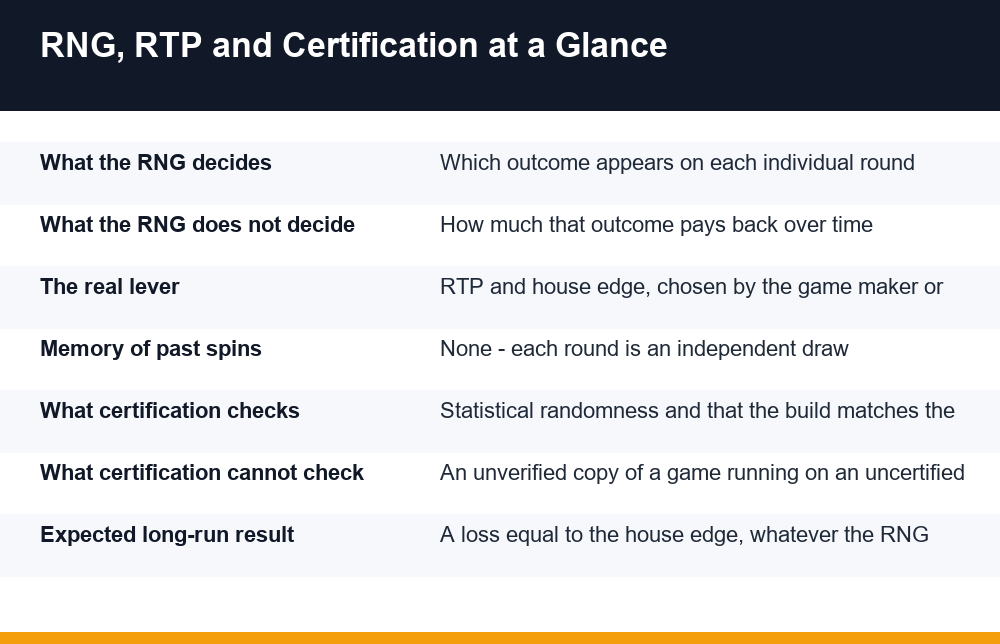
The clearest way to hold these apart is to ask what question each one answers. The RNG answers “which result?” RTP – return to player – answers “across a very large number of results, what proportion of staked money comes back?” A game can be impeccable on the first and brutal on the second. RTP is a design choice expressed as a percentage, and the house edge is simply the remainder: a 96% RTP means a 4% edge, meaning that for every unit staked over a long enough horizon, roughly four hundredths of a unit is expected to be retained by the house.
Many slot titles ship in multiple RTP configurations, and the operator selects which one to deploy. The same game name, the same artwork, the same sounds and the same certified generator can run at noticeably different returns depending on the setting in use. Nothing about the randomness changes between those versions. Only the mapping and the pay table change, which is exactly the lever the player cannot see and cannot influence.
| Property | RNG | RTP / house edge |
|---|---|---|
| What it controls | Which outcome occurs on a round | What outcomes pay, on average, over time |
| Who sets it | Algorithm, seeded by the system | Game maker, configured by the operator |
| Can it be checked externally | Yes, by statistical testing of outputs | Only by inspecting the maths model or reported figures |
| Does it have a direction | No – no bias toward player or house | Yes – always toward the house |
| Does play volume help | No effect at all | More volume moves results closer to the edge |
| Can strategy change it | No | Only by choosing a different game entirely |
There is a further trap in the word “average”. RTP is a long-run figure measured over millions of rounds, often more. A real session of a few hundred spins sits nowhere near it, and the gap is not small. High-volatility games can run far below their stated return for extremely long stretches and then deliver the balance in a handful of rounds. This is why reading a session result as evidence of anything about the RNG is a category error, and why the structure of a session matters more to your experience than any property of the generator. We look at that separately in our piece on how session structure shapes what you actually experience.
Volatility is the third variable people conflate with the other two, and it is worth separating cleanly. Two games can share an identical return figure and feel nothing alike: one pays small amounts frequently, the other pays almost nothing for long periods and occasionally returns a large multiple. Volatility describes the shape of the distribution, not its centre. It changes how quickly a bankroll is likely to disappear and how wide the swings are, but it does not move the expected result by a fraction of a percent. A low-volatility game at a given return and a high-volatility game at the same return cost exactly the same amount per unit staked over a long horizon.
Can Online Casinos Manipulate the RNG?
This is the question readers most want answered, and the honest answer has two halves. For a game supplied by an established studio and running as a verified build through an audited platform, the operator typically has no access to the generator at all – the game runs on the supplier’s servers, the operator receives results, and tampering would require compromising the supplier. In that setting, the realistic risk is not a rigged generator. It is a wide margin, aggressive pacing and a pay table you never examined. The house does not need to cheat when the published maths already guarantees the outcome.
The other half is less comfortable. Where an app is not running verified supplier builds – a cloned game, a reskinned title, a self-built product distributed outside app stores – the player has no mechanism to establish anything about how results are produced. The outcome engine might be random. It might be weighted dynamically against larger stakes, or against accounts that are up. It might not be a generator in any meaningful sense. The point is not that every such app is manipulated; the point is that you cannot tell, and “cannot tell” is the whole problem. An unverifiable claim of randomness carries no information.
It is also worth noting how little manipulation would be needed to matter, which is part of why the question feels so urgent to players. A shift of a couple of percentage points in the configured return would be invisible across any amount of play a single person could ever observe, and would never announce itself as a run of bad luck. That is precisely why the question cannot be settled by playing and watching. Nobody accumulates enough rounds to distinguish a sound generator from a slightly biased one by experience alone, which is the entire reason independent statistical testing exists as a separate activity.
A closely related pattern appears in simple prediction-style apps, where an interface offering a two or three-way choice invites the belief that outcomes can be read from history. Those products are often built in-house, with no external verification of the outcome logic at all, and the visible result history is the only evidence on offer – which is to say, no evidence. We examine that mechanic in detail in our breakdown of what sits behind colour prediction game outcome logic.
The practical conclusion is unglamorous. Worrying about whether a certified supplier’s generator is secretly weighted is mostly wasted energy; the published margin already explains the losses. Worrying about outcome logic you cannot verify at all is entirely rational, and the correct response to an unverifiable product is not caution but absence.
What Certification Proves and What It Does Not
Independent testing houses such as eCOGRA, iTech Labs and GLI run a defined set of checks on game software. Understanding the boundaries of those checks is the most valuable part of having casino rng explained properly, because the boundaries are where overconfidence creeps in.
What a typical evaluation does cover: the generator’s output is subjected to statistical batteries looking for bias, serial correlation and short cycles; the seeding process is reviewed so that outputs are not predictable from observable information; the mathematical model is examined and the theoretical return is calculated from the game’s own maths rather than taken on trust; and the submitted build is fingerprinted so that the tested version can later be distinguished from an altered one. Some reports also cover live return figures aggregated across real play, which is a different and useful kind of evidence.
- Proven: the tested build’s outputs are statistically indistinguishable from random across large samples.
- Proven: the game’s theoretical return matches the figure its maker states, as calculated from the maths model.
- Proven: the exact file or build submitted for testing can be identified later by checksum.
- Not proven: that the version you are playing is that build, unless the deployment itself is being checked.
- Not proven: that the return is favourable – certification confirms the figure, it does not endorse it.
- Not proven: anything at all about software the testing house never received.
That last line is the crux. A certificate is a statement about a specific artefact at a specific time. It is not a property that transfers to a website that displays the logo, to a cloned copy of the game, or to a different title from the same brand. When an uncertified app shows testing-house imagery, the overwhelmingly likely explanation is that the image was copied, and a copied logo is the cheapest possible thing to fake. Certification is meaningful precisely because it is narrow, and treating it as broad destroys the information it carries.
There is also a nuance about the number itself. A certified return figure describes the game as configured for the test. If a title supports several configurations, the report may apply to one of them. Reading a certificate therefore means reading which version and which return it refers to, not just noting that a certificate exists.
Worth distinguishing too are the two broad kinds of report these organisations produce. One examines software in a laboratory: the generator, the maths model, the build. The other looks at an operation over a period – live return figures aggregated from actual play, compared against what the model predicted. The second kind is the only evidence that connects a tested artefact to what players actually encountered, and it is also the kind most rarely shown. A page displaying a logo and nothing else is offering neither.
Do Slot Machines Remember Previous Spins?
No. Each round draws from the generator independently, and nothing about previous results feeds into the mapping that produces the next one. A game that has paid nothing for four hundred spins is not accumulating an obligation, and a game that has just paid a large amount is not entering a cold phase. The software holds no counter of what it owes you. This is not a claim about operator honesty – it is a structural property of how the outcome is produced, and it is one of the few things that holds across virtually every commercial product of this kind.
The belief persists because human pattern recognition is relentless and because genuinely random sequences look far less random than people expect. Long runs of the same outcome occur constantly in random data; clusters of near-misses are a predictable consequence of how symbol positions are distributed; and the feeling that a result is “due” is produced by the brain, not by the machine. Mechanical slot machines of the past had no memory either, so this is not a feature that online play introduced.
Presentation does a great deal of work in sustaining the illusion. Modern games are built to make outcomes feel narratively connected: reels that decelerate dramatically as a high-value symbol approaches the payline, and returns smaller than the amount staked that are nonetheless announced with the same celebratory sound and animation as a genuine win. Neither is a property of the generator. Both shape how a sequence of independent draws is remembered, which is why recollection of a session is a poor record of what actually occurred.
Two commonly confused exceptions are worth stating precisely. Progressive jackpots do carry a running total, but the total only changes the prize size, not the probability of triggering it. Some games include visible accumulators – collect five symbols to unlock a feature – and these are explicit, displayed mechanics forming part of the declared maths. Neither is hidden memory, and neither makes a result predictable.
The practical consequence is that every staking idea built on sequence – raising stakes after losses, stopping after a win on the assumption that a cold run follows, tracking histories for a pattern – rests on a premise the software does not implement. Each round is a fresh draw at the same margin, which is why no arrangement of stake sizes changes the expected result. The margin is the only thing compounding.
How to Check Whether a Game Is Certified
Verification is possible, but it requires going to the testing house rather than trusting what the product displays. The direction of the check matters enormously: start from the certificate and look for the game, never start from the logo and assume the certificate.
- Find the supplier name in the game’s own information panel or paytable screen, not in site marketing copy – the studio that built the title is the entity that would hold any certificate.
- Go to the testing house’s own website directly, typing the address yourself, and look for its public register or certificate search.
- Search for the supplier and the specific title. Absence from a register is not automatically damning, but it means you have no confirmation, which should be treated as the same thing as no certificate.
- Check what the certificate actually covers: which build, which date, which return configuration. A certificate from several years ago for a different version tells you little about today’s deployment.
- Open the game’s information panel and read the stated return figure and the maximum exposure. If no return figure is published anywhere in the product, treat that silence as the answer.
- Treat any logo that is a flat image with no link, or that links back to a page on the operator’s own domain, as decoration rather than evidence.
- If the app was installed from a file sent to you, from a messaging group, or from a download link outside an official store, stop here. Nothing above can be verified for software distributed that way.
Alongside the technical checks, it is worth knowing where to turn if play has stopped feeling like a choice, since that question has nothing to do with whether any generator is sound. Independent, non-commercial charities publish plain explanations of how these products are built to work and offer free confidential support – GamCare’s plain-language explanation of how gambling products work is a reasonable starting point, and it is written to inform rather than to sell.
One more honest note on this checklist: completing every step successfully does not make a product a good idea. It only removes one specific category of unknown. A fully certified game with a verified generator and a published return still carries a built-in margin, and that margin is the reason the product exists.
Six Mistakes to Avoid When Thinking About Randomness
Having casino rng explained correctly is mostly a matter of not making a handful of specific errors. Each of the following is common, each sounds reasonable, and each leads somewhere expensive.
- Treating randomness as fairness. Unpredictable results and favourable results are unrelated properties. The first is a technical fact; the second is a design decision that was made against you.
- Reading a session as data. A few hundred rounds carries almost no information about a figure measured over millions. Both a good session and a bad one are consistent with the same underlying maths.
- Assuming a logo is a certificate. Images are copied in seconds. Only a record on the testing house’s own site means anything, and only for the build it names.
- Believing results can be timed. No memory means no cycles, no due payouts, no hot or cold phases, and nothing for a tracker to track.
- Paying for a method. Anyone selling a way to beat an outcome engine is selling a claim they cannot demonstrate. If a method worked, the margin would be the thing that broke, and margins do not break.
- Ignoring the published return. The one number that genuinely predicts long-run results is usually printed in the game’s own information panel, and it is the number almost nobody reads.
Put together, the honest summary is short. The generator is almost certainly doing what it claims on established, verifiable products, and that fact is far less reassuring than it sounds. The outcome of extended play is governed by a margin that was set deliberately, published quietly, and left unchanged by every strategy ever devised. Where randomness genuinely cannot be verified – on cloned games and apps distributed outside any accountable channel – the correct reading is not that the odds are worse than stated but that there are no stated odds to rely on.
Understanding the mechanism is worth doing anyway, because it dismantles the stories people tell themselves about patterns and about being owed a result. It just does not produce an advantage. No arrangement of stakes, timing or game selection converts a negative expectation into a positive one, and treating any amount staked as money already gone is the only framing that matches how the mathematics actually behaves. Adults only; real-money play carries risk, and losses are the expected outcome. That is casino rng explained without the mystique: a number generator, a mapping, and no memory.
Frequently Asked Questions
How does an RNG work in casino games?
A pseudorandom number generator runs continuously from a seed value, producing a long sequence of numbers that passes statistical tests for randomness. When you commit a stake, the software takes the current number and maps it onto the game’s outcome table – reel positions, a roulette pocket, a shuffle order. The outcome is fixed at that moment; the animation that follows is presentation only. The generator treats every number as equally likely, and the designer decides how many numbers correspond to each result.
Can online casinos manipulate the RNG?
On established products the game usually runs on the supplier’s servers, so the operator has no access to the generator and tampering would mean compromising the supplier. In that setting the realistic issue is not a rigged generator but a wide published margin. On cloned games or apps distributed outside official channels, however, you have no way to establish anything about the outcome logic. The problem there is not proven manipulation but unverifiability – an unverifiable claim of randomness carries no information at all.
What is the difference between RNG and RTP?
The RNG answers which outcome occurs on a given round. RTP answers what proportion of staked money returns across a very large number of rounds. They are independent: a game can be statistically perfect and still retain a substantial share of everything staked, because the pay table – not the generator – sets the economics. RTP is a design choice made by the game maker and configured by the operator, and the house edge is simply the remainder.
How do I know if a casino game is certified?
Find the supplier name in the game’s own information panel, then go directly to the testing house’s website and search its public register for that supplier and title. Check which build, which date and which return configuration the certificate covers. Treat a flat logo image, or one linking back to the operator’s own domain, as decoration rather than evidence. If the app came from a file or link outside an official store, none of this can be verified.
Do slot machines remember previous spins?
No. Each round is an independent draw and nothing from earlier results feeds into the next outcome. A long losing run creates no obligation and a large win does not trigger a cold phase. Progressive jackpots track a prize total but not a trigger probability, and visible collect-style accumulators are declared mechanics rather than hidden memory. This is why staking plans based on sequence rest on a premise the software does not implement.